
Searching Marion County Property Records
Marion County covers Indianapolis and, through a consolidation the locals call Unigov, shares a government with it. For a property searcher the useful surprise is not the consolidation. It is that a deed in Indiana does not go straight to the recorder, and a conveyance that skips the intermediate step comes back rejected.
Knowing the order of offices is most of what an out of state searcher needs here.
The Auditor sees the deed first
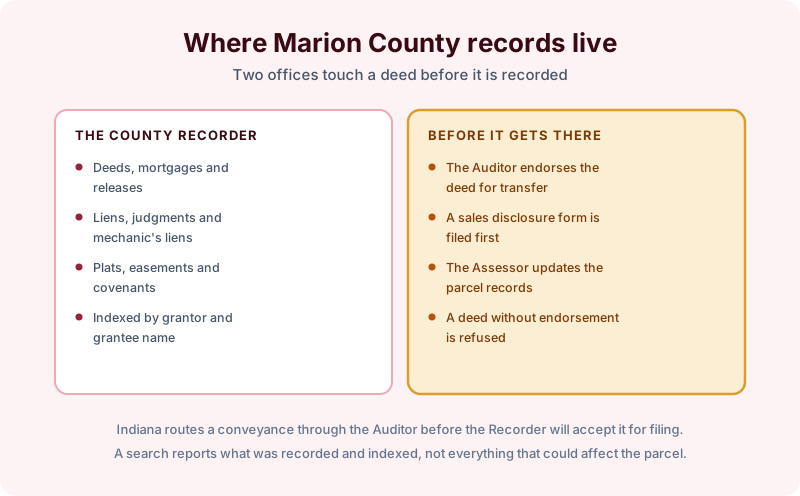
Indiana routes a transfer through the County Auditor before the Recorder will accept it. The auditor endorses the deed for transfer, which updates the ownership records used for taxation, and a sales disclosure form is filed as part of the same process. Only then does the instrument go to the Recorder to be indexed.
The practical consequence for a searcher is that the recorded date on a deed can sit some days after the date it was signed and delivered, because the endorsement step takes time. Where a chain shows an unexpected gap of a week or two, this is frequently the explanation rather than anything substantive.
It also means the auditor's records and the recorder's records can disagree briefly, and they answer different questions. The auditor knows who is billed for the tax. The recorder knows what was conveyed. On a disputed transfer it is worth pulling both rather than treating either as the whole answer.
The sales disclosure form is itself useful. Indiana collects transfer price information through it, which means sale prices are generally obtainable here in a way they are not in the non-disclosure states.
What the Recorder holds
Deeds, mortgages and releases, liens and judgments, mechanic's liens, plats, easements and recorded covenants, all indexed by grantor and grantee name. It is an ordinary recording office once the instrument reaches it, and the name indexes behave the way they do everywhere.
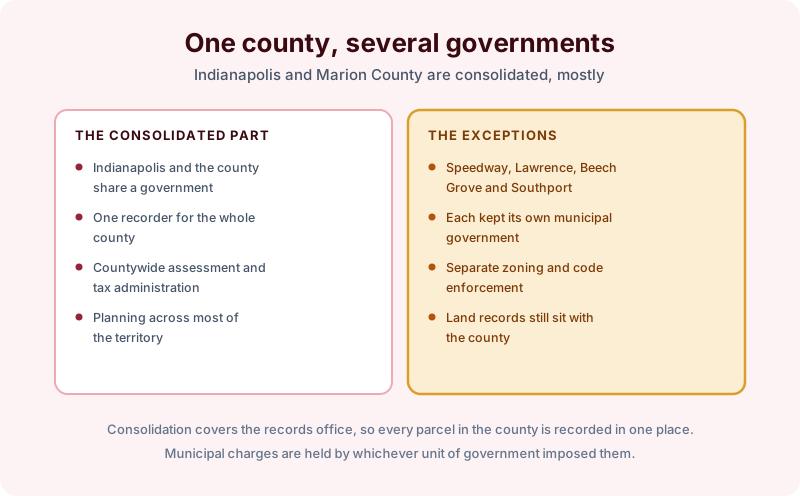
Because the county is consolidated, there is one recorder for the whole territory. A searcher working an Indianapolis address does not have to establish which municipality it sits in before finding the land records, which is a genuine simplification compared with metropolitan areas built out of dozens of separate jurisdictions.
The towns that stayed separate
Consolidation was not total. Speedway, Lawrence, Beech Grove and Southport kept their own municipal governments, with their own zoning and their own code enforcement. Land records for parcels in those towns still sit with the county recorder, so the search itself does not change.
Those towns are small relative to the county and easy to overlook, and a buyer who assumes Indianapolis zoning applies to a Speedway parcel has assumed wrong. The land records question is unaffected; the regulatory one is not.
What does change is where municipal charges live. A code enforcement matter, a demolition cost, or an unpaid municipal bill is held by whichever unit of government imposed it, and none of that is a land records question unless it was reduced to a recorded lien.
Tax sales in the chain
Indiana runs an annual tax sale for delinquent property taxes, and a purchaser at that sale receives a certificate rather than the property. Title passes only after the redemption period expires and a tax deed is issued, and in some cases a further commissioners' sale follows for parcels that did not sell.
Where a tax sale appears in a chain, the questions are whether the tax deed was properly issued and recorded, whether the statutory notices were given, and whether a later action confirmed the result. What survived the sale is a matter of statute and a legal conclusion for counsel licensed in Indiana rather than for an abstractor.
Ordering a Marion County search
Supply the street address, the parcel number, and the current owner name. Where a recent transfer is involved, expect the auditor endorsement to sit between the signing date and the recording date, and ask for both if the sequence matters to your question.
A title search reports what has been recorded and indexed as of the date it is run, in the offices searched. It is not an inventory of municipal charges, and recording practice varies from one Indiana county to the next.