

Searching Franklin County Property Records
Franklin County is Columbus and the ring of suburbs around it, and it has been one of the fastest growing counties in the Midwest for twenty years. The land records themselves are orderly. What catches people out is that Ohio splits the record across separate offices, and that a deed has to visit one of them before the office you were expecting will even take it.
Knowing which office answers which question is most of the work.
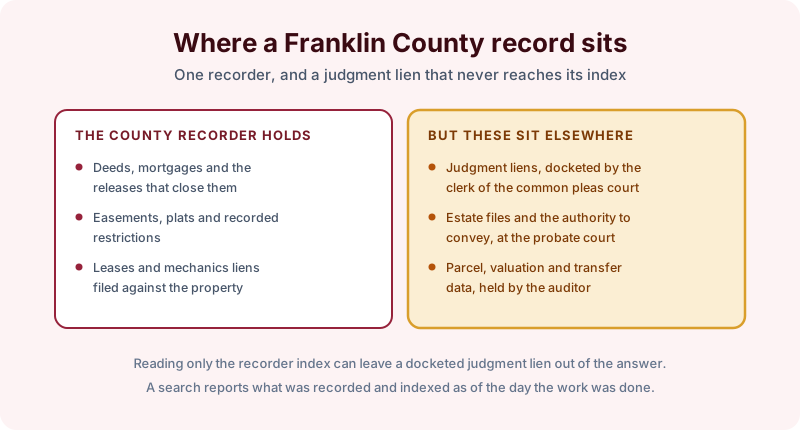
Three offices hold the Franklin County record
The county recorder holds the land records. Deeds, mortgages and the releases that close them, easements, plats, leases, mechanics liens and recorded restrictions, indexed by party name.
The county auditor is the assessor and the keeper of the parcel. Valuation, the tax map, the parcel number and the transfer history live there, and none of that is a recorded instrument.
The clerk of the court of common pleas holds something a land search genuinely needs. In Ohio a money judgment does not attach to real estate simply because it was entered. It attaches when a certificate of judgment is filed with the clerk in the county where the land lies, and the clerk keeps that docket. A searcher reading only the recorder's index can miss a judgment lien completely. The probate court is a fourth stop whenever the chain runs through a death, because real property in an Ohio estate frequently passes on a certificate of transfer that traces back to the probate file.
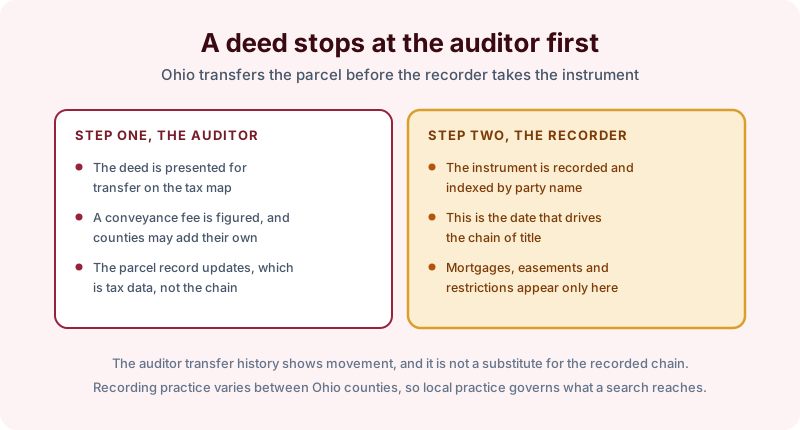
A deed goes to the auditor before the recorder
Ohio runs conveyances through the auditor first. The deed is presented there for transfer, a conveyance fee is figured and the parcel record is updated, and only then does the instrument go on to the recorder to be recorded and indexed. Counties may add a permissive fee on top of the state rate, so the amount is a local question.
Two practical consequences follow. The auditor's transfer history is a quick way to see what has moved, but it is tax data rather than the chain of title, and it will not show you a mortgage, an easement or a restriction. And the date that governs priority is the recording date at the recorder's office, not the day the auditor stamped the deed.
A Columbus address is not always Franklin County
Columbus has annexed outward for decades and now reaches into Delaware, Fairfield and Licking counties. Dublin, Westerville, Reynoldsburg, New Albany and Canal Winchester straddle county lines in the same way, and a mailing address gives no reliable signal about which courthouse holds the record.
Land records follow the land. Confirm the county from the parcel number and the legal description rather than from the city on the envelope, because a search run in the wrong courthouse comes back clean on a parcel it never looked at. Where a development crosses a line, the instruments are split between two sets of books and both have to be read.
How far back the search should run
Ohio has a marketable title statute that can extinguish older interests when nothing was filed to preserve them after a root of title, and a separate regime for dormant mineral interests. Both are legal doctrines rather than search settings, and whether a given interest survived is a question for Ohio counsel.
What they mean in practice is that the term you pick changes the answer you get. A current owner search shows the present picture. A longer term reaches back through more deeds, more releases, and more of the old restrictions a subdivision, a railroad or a mineral reservation left behind. Ask for the term that matches the decision you are making.
Ordering a Franklin County search
Supply the street address, the auditor's parcel number and every name the property has been held in. Say whether the chain runs through an estate or a foreclosure, because each of those puts part of the answer in a court file rather than in the recorder's books.
A title search reports what was recorded and indexed in the offices searched, as of the day the work was done. It is not proof that nothing else exists, and recording practice varies from one Ohio county to the next.