

Searching St. Louis County Property Records
The most useful thing to know about searching property records around St. Louis has nothing to do with how the records are kept. It is that the City of St. Louis and St. Louis County are two separate jurisdictions, and have been since 1876. A search of one reaches nothing in the other.
Get that right and the rest of the work is straightforward Missouri practice. Get it wrong and the report comes back empty on a parcel that is perfectly well documented a few miles away.
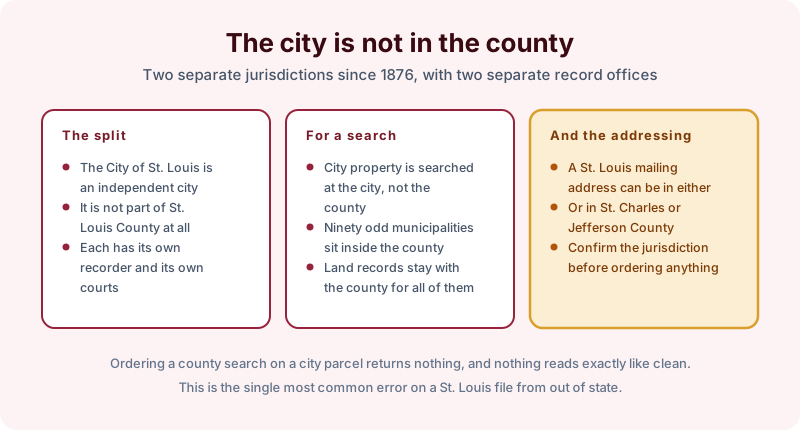
The city is not in the county
The City of St. Louis is an independent city, which means it sits outside any county and performs county functions for itself. It has its own Recorder of Deeds, its own courts and its own assessor. St. Louis County surrounds it on three sides and does not include it.
Inside the county sit roughly ninety municipalities, from Clayton and Kirkwood down to villages of a few hundred people. Those do not complicate the land records, because the county recorder holds the records for all of them. They complicate code, zoning and permit questions, which have to be asked of the individual municipality.
The trap is the mailing address. A property with a St. Louis address may sit in the city, in the county, or in St. Charles or Jefferson County entirely. Confirming the jurisdiction before anything is ordered is the single most valuable minute spent on one of these files.
Three offices hold the record
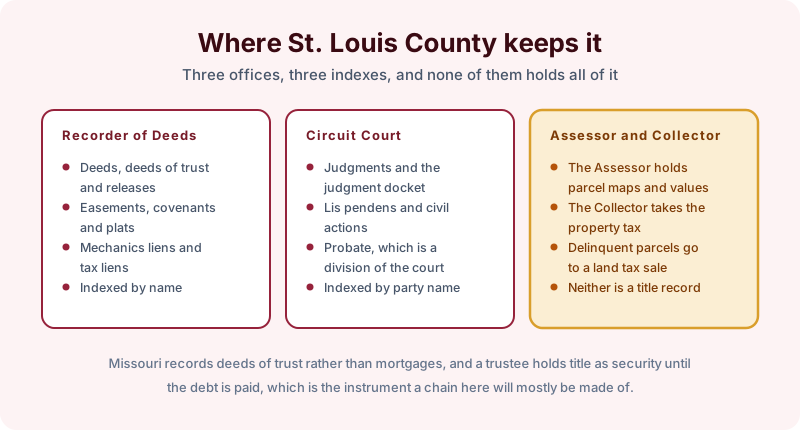
The Recorder of Deeds holds the land records for the county. Deeds, deeds of trust and their releases, easements, restrictive covenants, plats, mechanics liens and tax liens, indexed by the names of the parties.
Court filings sit with the Circuit Court. Judgments and the judgment docket, lis pendens, civil actions, and probate, which in Missouri is a division of the circuit court rather than a separate court. Neither office shares an index with the other.
Assessment and collection are separate again. The Assessor maintains parcel maps and valuations, and the Collector of Revenue takes the property tax. Delinquent parcels move to a land tax sale, which is a recorded process and does appear in the land record even though the assessment itself is not a title record.
What a St. Louis County search covers
- The chain of title over the term you specify, with the recorded instruments attached rather than summarized.
- Deeds of trust and releases. Missouri uses deeds of trust rather than mortgages, and a trustee holds title as security until the debt is paid.
- Liens and judgments of record, including mechanics liens, tax liens and judgments docketed against the owner.
- Easements, covenants and plat restrictions, which in the older inner ring suburbs regularly predate 1930 and are frequently still enforceable.
- Tax status, including whether a parcel has moved into the land tax sale process.
What the record will not tell you
An unrecorded instrument is not in the index, and under Missouri law a conveyance can be valid between the parties while being ineffective against a later purchaser without notice. Whether that applies in a given situation is a legal question for counsel rather than for an abstractor.
Boundaries are the other limit. A legal description is not a survey and a search does not locate anything on the ground. Nor does it report the condition of a building, who is occupying it, or whether a municipal code case is open.
Ordering a St. Louis County search
Supply the street address, the locator number from the Assessor if you have it, and every name the property has been held in, including trusts and entities. Tell us whether the parcel is in the city or the county if you already know, and we will confirm it if you do not.
A title search reports what was recorded and indexed in the offices searched, as of the day the work was done. It is not proof that nothing else exists, it is not a title insurance commitment and it is not a legal opinion. Our report names the indexes reviewed and attaches copies of what was found.