

Searching Ada County Property Records
Ada County holds Boise and most of the state's population growth, and a property search there runs through an office arrangement that looks unusual to anyone used to larger states. In Idaho a single elected official carries several titles at once, and the practical result is that the land records and the district court file are reached through the same office rather than through two.
That is a convenience. It is not a shortcut, and treating it as one is the most common mistake in an Idaho search.
One office, more than one role
Idaho assigns the recorder function to the county clerk, who also serves as auditor and as clerk of the district court. In Ada County the office is titled accordingly, and its land records run back to the territorial period.
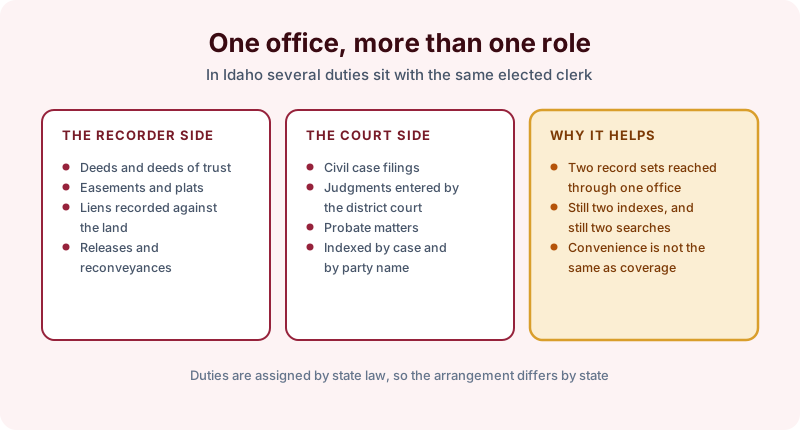
The two sides answer different questions. The recorder side holds deeds, deeds of trust, easements, plats and the liens recorded against the land, along with the releases and reconveyances that clear them. The court side holds civil filings, judgments and probate matters, indexed by case and by party.
They remain two indexes. A search of one is not a search of the other, and a report that says the county records were searched should say which of the two it covered.
Deeds of trust rather than mortgages
Idaho lending is dominated by the deed of trust, which names a trustee alongside the lender and borrower and allows a non-judicial foreclosure conducted by the trustee rather than through a lawsuit.
For a search that changes what the paper trail looks like. A completed non-judicial foreclosure generally produces a recorded notice of default, a notice of sale and a trustee's deed, all in the land records, with no court case anywhere. A judicial foreclosure, which is also available, leaves its trail in the court file instead. Finding one and not the other is a reason to look in the other place rather than a reason to conclude nothing happened.
Community property changes who signs
Idaho is a community property state, and that reaches directly into conveyancing.
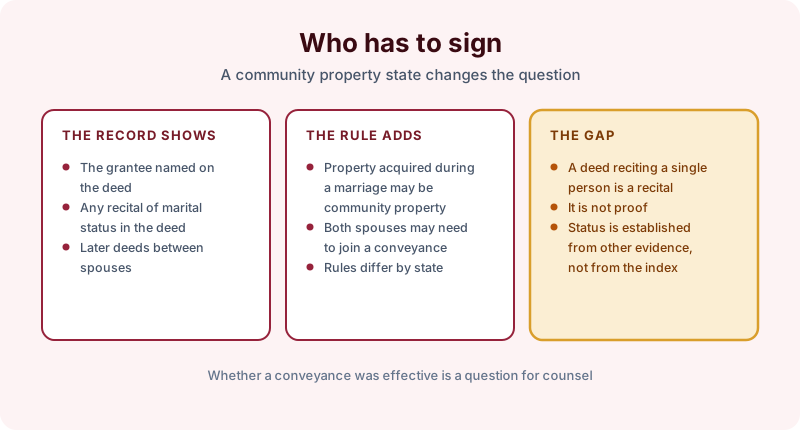
Property acquired during a marriage may be community property regardless of whose name appears on the deed, and a conveyance of community real property generally requires both spouses to join. A deed reciting that the grantor is a single person is a recital, which is a statement made by the party rather than a fact anybody verified at the counter.
What a search contributes is the sequence. Every deed, every recital, and the dates they were recorded, so that somebody evaluating the chain can place them against a marriage. What it cannot do is establish marital status, which comes from other evidence entirely.
Where the other answers live
Two more offices matter and neither is the recorder. The assessor maintains parcel data, ownership as the county understands it for assessment purposes, and the parcel numbers most people search by. The treasurer collects property taxes and knows what is delinquent.
- Assessor data is a finding aid, not a title record. It can lag a conveyance and it does not establish ownership.
- Tax status comes from the treasurer rather than from the recorded documents.
- Plats, surveys and corner records sit with the recorder and the county surveyor.
What a search covers, and what it does not
An AFX search reports the instruments found of record for the property searched, in the offices searched, over the term searched, under the names and descriptions given. It is not an inventory of everything that could affect the property, and an empty result does not establish that a parcel is unencumbered.
Recording and indexing practice varies county by county, and the combined office arrangement described here is Idaho's rather than the country's. Whether anything found has a particular legal effect, including whether a conveyance of community property was effective, is a conclusion for an attorney licensed in Idaho.