

Searching Alameda County Property Records
Alameda County runs along the east side of San Francisco Bay, from Albany and Berkeley down through Oakland and Hayward to Fremont, with the Livermore valley behind the hills. Fourteen cities sit inside it, and that number is the first thing to know about searching here, because a meaningful share of what affects a parcel is set by the city rather than by the county.
Knowing which office answers which question is most of the work.
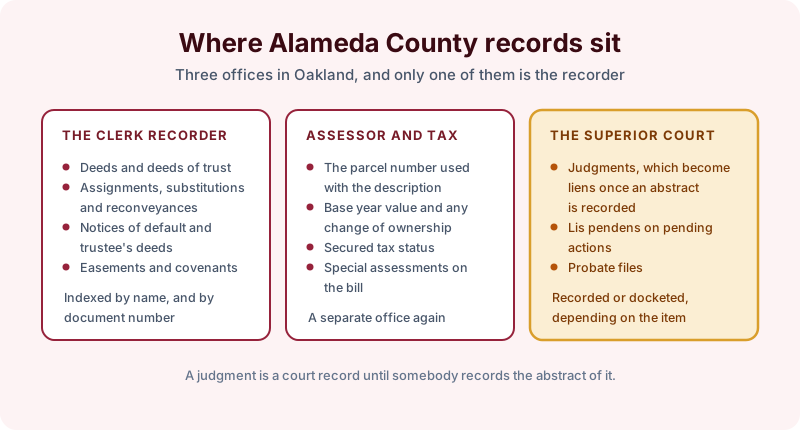
Three offices hold the Alameda County record
The clerk recorder holds the land side. Deeds, deeds of trust, assignments, substitutions of trustee, reconveyances, notices of default, trustee's deeds, easements and recorded covenants are filed and indexed there by name and by document number.
California uses deeds of trust rather than mortgages, and most foreclosures run outside court, so a chain here reads as a sequence of recorded notices rather than as a lawsuit. That makes the recorded file unusually complete for a foreclosure, which is one of the few places the record tells most of the story.
The assessor and tax collector hold the parcel number, the ownership shown on the roll, the base year value and the secured tax status. The roll follows the recorded deeds rather than the other way round, so it is a fast route from an address to a parcel and it is not evidence of ownership.
The superior court holds judgments and pending actions. A money judgment is a court record until somebody records an abstract of it, and only then does it attach to real property in the county. That two step is worth remembering, because a judgment can exist without yet being a lien.
Trusts hold a lot of California title
Revocable living trusts are used heavily in California, and a very large share of Bay Area homes are vested in one. The practical consequence for a search is that the grantee on the last deed is frequently a trust name rather than a person, and the index runs on exactly what was typed.
Trust names are typed inconsistently. A dated trust, a restated trust and an amended trust may all appear with slightly different wording, and a search run against one spelling can miss an instrument recorded under another. Give us every version of the name you have seen, along with the individual names behind it.
The city matters as much as the county
This is the part that surprises people coming from a single jurisdiction county. Several Alameda County cities impose their own real property transfer taxes, at rates that differ substantially from one city to the next and from the county rate. A property in Oakland, Berkeley or Alameda does not cost the same to transfer as one a few miles away.
Seismic and inspection programs are also city level. Soft story retrofit requirements, point of sale inspection programs and similar ordinances are administered locally, and some of them generate a recorded notice against the parcel while others live only in a city file.
So when you order, name the city as well as the county. It changes which questions are worth asking.
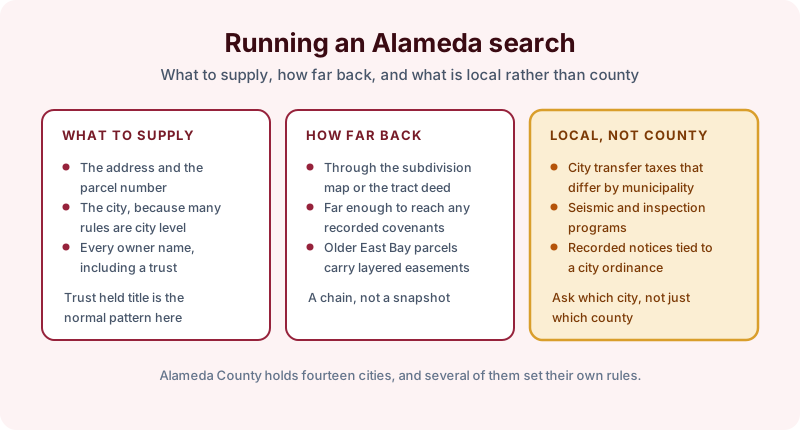
How far back a search should reach
Most East Bay neighborhoods were platted between the 1880s and the 1950s, and the recorded covenants, utility easements and setback restrictions attached to a parcel were usually created by the subdivision map or the tract deed rather than by anything recent.
A current owner search will not reach them. A chain search back through the tract instrument will, and on a parcel with a shared driveway, a rear easement or a steep lot with drainage rights running across it, that is where the answer lives.
What an Alameda County search covers
Send us the address, the parcel number, the city and every owner name across the period you want covered, including each version of a trust name. The names are what the index actually runs on.
A search reports what was recorded and found in the indexes reviewed over the term searched. It is not an inventory of everything affecting the property, an empty result does not prove there is nothing to find, and whether title is marketable is a legal conclusion for an attorney licensed in California.