

Searching Baltimore City Property Records
Baltimore City is not in a county. It is an independent city, which means its land records are kept by its own clerk rather than by a county seat, and a search run against Baltimore County by mistake returns a different jurisdiction entirely. That is the first thing to get right, and it catches people more often than you would expect.
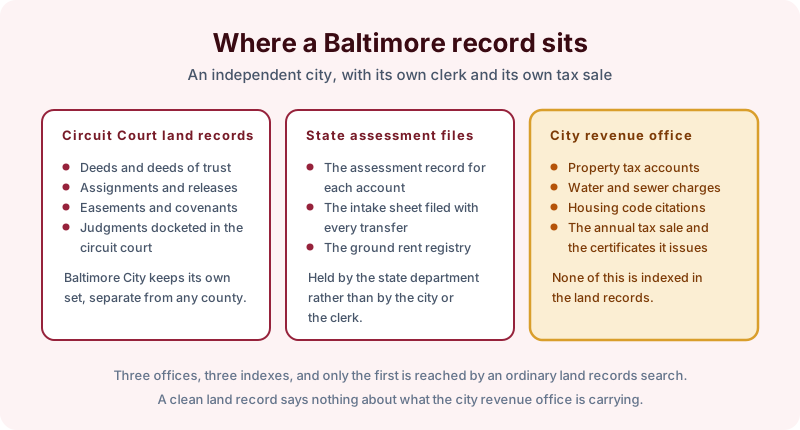
The second is that the record on a Baltimore property is split across three offices, and only one of them is a land record.
Where the land records are kept
Maryland records land through the clerk of the circuit court in each jurisdiction, and Baltimore City has its own. Deeds, deeds of trust, assignments, releases, easements and covenants are recorded and indexed there by grantor and grantee name, alongside the judgments docketed in that court.
Before a deed can be recorded it has to clear two gates that are not part of the clerk's index. Recordation and transfer taxes have to be paid, and the city endorses the instrument to show it. A state intake sheet accompanies every transfer and feeds the assessment record. Neither of those is what a title examiner reads, but a deed that failed one of them never reached the books at all, which is a common explanation for a chain that appears to skip an owner.
Ground rent, and the house that sits on leased land
Thousands of Baltimore rowhouses are held in leasehold rather than fee simple. The buyer owns the house and holds a long lease of the ground beneath it, frequently ninety nine years and renewable, with a small annual rent payable to whoever holds the reversion. It is a Maryland arrangement, concentrated in this city, and nothing on the face of a modern deed necessarily announces it.
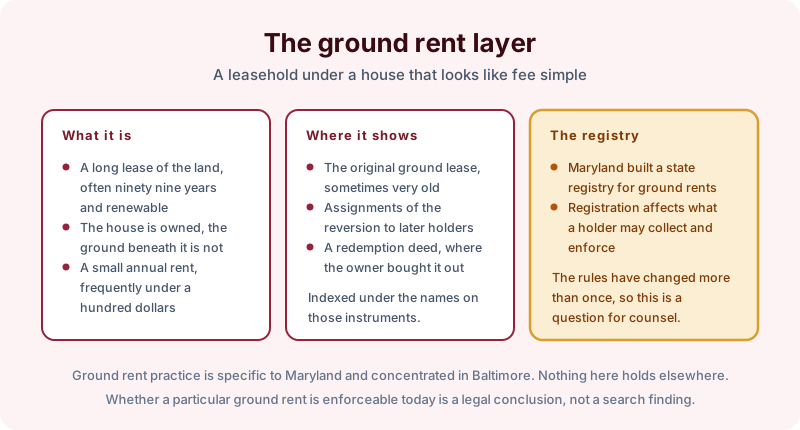
What a search can find is the original ground lease, any assignment of the reversion to a later holder, and a redemption deed where an owner bought the ground rent out. Maryland also built a state registry for ground rents, and registration affects what a holder may collect and enforce. Those rules have been litigated and amended more than once, so whether a particular ground rent is enforceable today is a question for a Maryland attorney rather than a search result.
The tax sale and what it leaves behind
Baltimore City runs an annual tax sale, and the certificates it issues are a live feature of the record rather than a historical curiosity. Unpaid property taxes, water charges and certain municipal liens can put a property into the sale, a bidder buys the certificate, and a foreclosure of the right of redemption follows if the owner does not redeem within the statutory period.
Two practical points follow. The underlying charges sit with the city revenue office, not in the land records, so a clean chain says nothing about what is owed on an account. And where a tax sale foreclosure did complete, the resulting decree is the instrument that matters in the chain, and the parties who had to be notified are worth reading rather than assuming. A ground rent holder is one of the interests that can be affected, which is another reason the leasehold question and the tax question are not as separate as they look.
What a Baltimore City search covers
A records search here reports the chain over the term ordered, the deeds of trust and their assignments and releases, judgments docketed against the names searched, easements and covenants, any recorded ground lease or redemption, and the status of what is indexed in the land records.
It does not reach the city revenue account, the housing code citation file, or the permit history, and it does not establish whether a ground rent holder may still collect. Those are separate requests to separate offices, and on a city property they are worth starting early. Recording and indexing practice varies by jurisdiction, and an empty result means nothing was found of record for the names and term searched rather than that nothing exists.