

Reading the Broward County Official Records
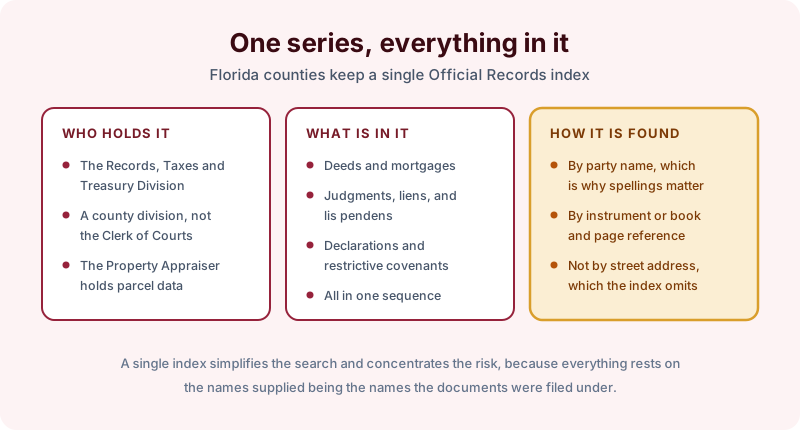
Broward County searches trip up people who have worked in other Florida counties, and the reason is a single structural fact. In most of the state the Official Records are kept by the Clerk of the Circuit Court. In Broward they are not. They are maintained by the county's Records, Taxes and Treasury Division, which is the statutory repository for the county's Official Records and also handles tax collection.
Get that right and the rest is orderly, because Florida's recording system is one of the simpler ones to search once you are at the right counter.
One index, nearly everything in it
Florida does not split land records into separate deed books, mortgage books and lien books. There is a single Official Records series per county, running in one continuous sequence, and deeds, mortgages, assignments, satisfactions, judgments, liens, lis pendens, declarations and restrictive covenants all go into it together.
- Records, Taxes and Treasury holds the Official Records and records new instruments into them.
- The Property Appraiser holds parcel folio numbers, legal descriptions and the owner shown on the roll, which is where an address search starts.
- The Tax Collector holds the tax position, including whether a certificate has been sold on unpaid taxes.
- The courts are where judgments originate, and a judgment reaches real property in the county by being recorded in the Official Records.
The index is built on party name and instrument number, not street address. A single sequence makes the search cleaner and concentrates the risk in one place, since everything depends on the names you supply matching the names the documents were filed under.
Where Broward liens actually come from
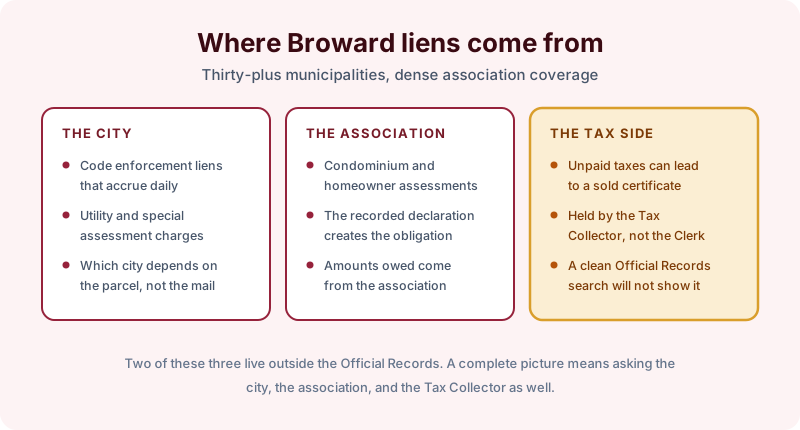
Broward has more than thirty municipalities and very dense association coverage, and both show up in the lien picture.
- Municipal code enforcement liens. These are recorded by the city rather than the county, and in many jurisdictions they accrue at a daily rate while a violation goes uncorrected, so an old one can be far larger than it first appears.
- Association assessments. Condominium and homeowner association obligations are created by a recorded declaration, but the amount currently owed sits with the association, not in the Official Records.
- Unpaid property taxes. Florida sells tax certificates on delinquent taxes, and that process is administered by the Tax Collector. A clean Official Records search does not show it, which is why our note on tax certificates and tax deed sales in Florida treats it as a separate enquiry.
- Recorded judgments and federal tax liens, found by name.
Two of those three are outside the Official Records entirely, which is the single most useful thing to understand about a Florida lien search and the reason a municipal lien search is ordered alongside rather than instead of a title search.
Reading a Broward chain
Two features of Florida practice are worth knowing when the chain is long. Florida has a marketable record title statute that can, in defined circumstances, extinguish certain older interests, and it has its own rules on how homestead status affects conveyance and devise. Neither is something a search decides. Both are reasons the recorded documents themselves, rather than a summary of them, are what counsel needs in front of them.
Deed types matter too. A quitclaim in the chain conveys whatever the grantor had and warrants nothing, which is a different starting point from a warranty deed, and our note on grant deeds and quitclaim deeds sets out the distinction.
What a search cannot settle
A search reports what was recorded and indexed in Broward County over the period searched, with copies of the instruments found. It will not give you a payoff figure, an association estoppel balance, or a municipal account status. It will not decide whether a lien is valid or how competing interests rank, which are legal questions. And it cannot show an unrecorded claim.
An empty result reflects the record searched. It is not proof that nothing is owed.
Ordering a Broward County search
For a specific property, a search of the Official Records against the parcel plus a name search against every owner is the practical minimum, and adding the municipal, association and tax positions is what makes the picture complete. Our guide to Miami-Dade County property records covers the neighbouring county, where the office holding the records is not the same one.
AFX Research has searched Broward and every other Florida county since 1995, including in-person retrieval where an older instrument is not available as an online image.