

Searching Bucks County Property Records
Bucks County sits at the eastern edge of Pennsylvania, with records running back to the 1680s and a courthouse arrangement that splits property information across more offices than most people expect. A search that reaches only the Recorder of Deeds will come back clean on a property that has a judgment against its owner and two years of unpaid taxes.
The split is not a quirk of this county. It is how Pennsylvania counties are organized, and knowing which office answers which question is most of the work.
Three offices, not one
The Recorder of Deeds holds instruments filed against land. The Prothonotary, an old title that simply means the chief clerk of the civil court, holds the civil case record including money judgments. The Tax Claim Bureau holds delinquent real estate taxes and runs the sales that follow them.
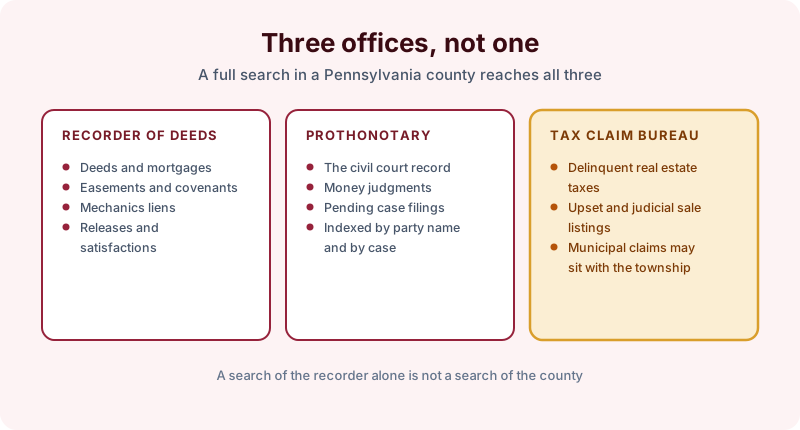
Municipal claims for water, sewer and code enforcement frequently sit somewhere else again, with the township or borough rather than with the county, which makes four places a thorough search may have to reach.
What the Recorder of Deeds holds
This is the land record in the ordinary sense. Deeds, mortgages and their assignments and satisfactions, easements, rights of way, declarations and restrictive covenants, and mechanics liens.
Bucks County's holdings are deep by American standards, with land records reaching into the seventeenth century, which matters on older parcels where a reservation or a right of way was created long before anyone involved today was born. A 30 year search does not reach a 1790 easement, and in this part of the country that is a live consideration rather than a theoretical one. Older instruments are also indexed by hand, in books, which is why the term chosen for the search changes the cost as well as the coverage.
Why judgments are somewhere else
This is the single most consequential thing to understand about a Pennsylvania search.
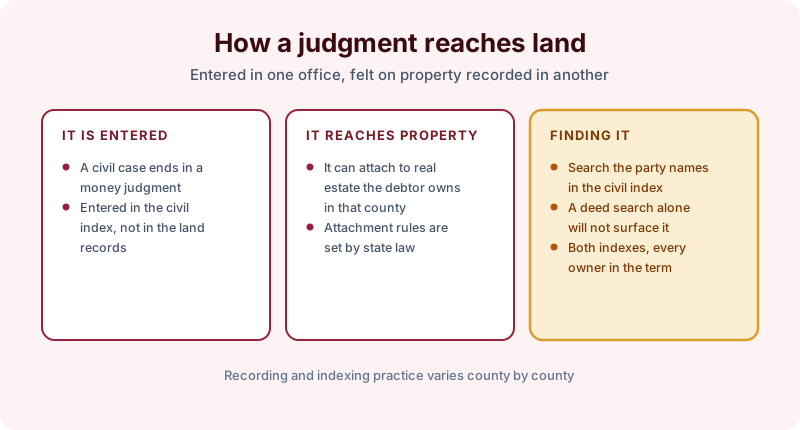
A money judgment is entered in the civil index kept by the Prothonotary. Under Pennsylvania law a judgment so entered can attach to real estate the debtor owns in that county, which means a lien reaches the property without anything at all being filed in the Recorder of Deeds.
The consequence for a search is direct. The judgment is found by searching names in the civil index, for every owner across the term being searched, and a search of the land records by parcel will not surface it. Exactly how and when a judgment attaches, and how long it lasts before it has to be revived, are matters of state law and belong to counsel.
Taxes, transfer tax and the sales that follow
Delinquent real estate taxes run through the Tax Claim Bureau, which conducts upset sales and, for properties that do not sell, judicial sales that can convey free of most liens. A buyer at one of those sales inherits a title history worth examining closely.
- Pennsylvania imposes a realty transfer tax, collected at recording and commonly shared between the state and the local taxing bodies.
- A deed may be recorded with a statement of value claiming an exemption, and that statement is part of the record.
- Municipal claims for utilities and code enforcement may never appear in the county record at all.
What a search covers, and what it does not
An AFX search reports the instruments found of record for the property searched, in the offices searched, over the term searched, under the names and descriptions given. Which offices were reached is the question to ask before relying on any report, because in Pennsylvania the answer genuinely varies.
An empty result does not establish that a property is free of claims, and recording and indexing practice varies county by county. Whether a judgment has attached, been revived or expired, and whether a tax sale conveyed clear title, are legal conclusions for an attorney licensed in Pennsylvania rather than findings an abstractor makes.