

Searching Chittenden County Property Records
Chittenden County is Vermont's largest county by population, taking in Burlington, South Burlington, Essex, Colchester, Williston and Shelburne along the eastern shore of Lake Champlain. If you are searching property records there, the first thing to understand is that the county has nothing to do with it. Vermont records land records by town and by city, and the county is not a recording jurisdiction at all.
That is not a quirk of local administration. It is written into state law and into the state constitution, and it changes how a search has to be ordered. You are not searching Chittenden County. You are searching Burlington, or Williston, or Hinesburg, one town at a time.
Where the records actually sit
Each organized town and city in Vermont keeps its own land records, and the town or city clerk is the officer who records them. Deeds, mortgages, discharges, easements, covenants and liens are entered in that town's books, indexed by the names of the parties, and stay there. Burlington's clerk holds Burlington's records. Williston's clerk holds Williston's. Nothing is consolidated upward.
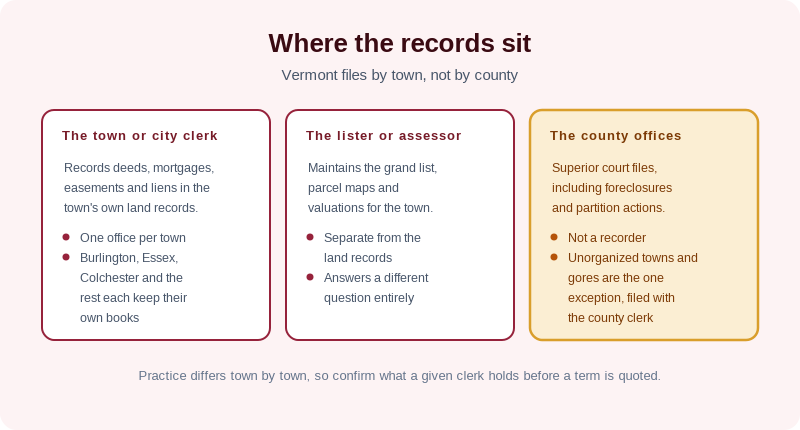
Two other offices matter and neither one records deeds. The lister or assessor maintains the grand list, the parcel maps and the valuations for that town, which answers a question about value rather than about title. The county superior court holds case files, including foreclosures and partition actions, and those are worth checking when the chain suggests litigation. There is one genuine exception to the town rule. Conveyances of land in an unorganized town, gore or grant are recorded by the clerk of the county the land lies in, and Vermont still has a handful of those.
What a town level search covers
The mechanics are straightforward once the jurisdiction is settled. An abstractor works the grantor and grantee indexes for the town the parcel sits in, over whatever term the order specifies, and pulls copies of the instruments found.
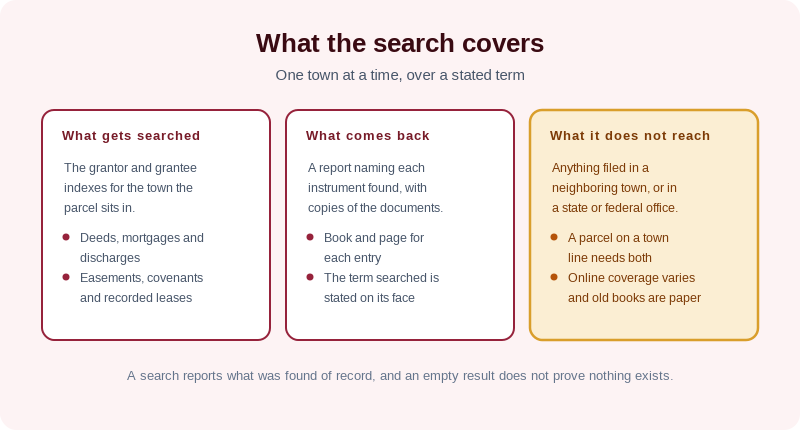
What comes back is a report naming each instrument, with the book and page for every entry and the term searched stated on its face, together with document copies. What it does not reach is anything filed somewhere else. A parcel that straddles a town line needs both towns run, and anything filed with a state or federal office is a separate inquiry.
What is online and what is not
Online coverage varies town by town, and there is no statewide portal that pulls it together. Burlington publishes its land records through an online index, and the city also runs a separate property database for parcel and permit information. South Burlington offers its own online land records, reaching back several decades, through its clerk's office with access and printing fees. Smaller towns in the county range from a searchable index to nothing at all, and older books in many towns remain paper.
The practical consequence is that a remote search is reliable for some towns and some date ranges and not for others. Where the term reaches back past what a clerk has imaged, somebody has to be in the office. That is ordinary work, but it has to be planned for rather than discovered halfway through.
Ordering a search in Chittenden County
Give us the town along with the address, because the town is the jurisdiction. Give us the parcel identifier if you have it, the owner names you want run, and the term you need. We will confirm what that clerk holds and how far back the records are accessible before anything is ordered, and where a parcel sits on a town line we will tell you that both towns need to be searched rather than quietly searching one.
A records search reports what was found of record in the office searched, over the term searched. It is not an inventory of everything that exists, an empty result does not prove a parcel is unencumbered, and recording and indexing practice varies from one town clerk to the next, so no local habit should be read as a statewide rule. Whether a given instrument is effective is a legal question for an attorney licensed in Vermont rather than a conclusion a search can reach.