

Searching Cumberland County Property Records
Maine keeps its deeds at a county registry, which makes it look like most of the country, and then does something with unpaid property taxes that almost nowhere else does. A town that is owed tax files a lien certificate at the registry, waits eighteen months, and if nobody redeems, the town owns the property. No auction, no sheriff, and no court proceeding. The whole foreclosure happens in the deed index.
Cumberland County is the state's most populous, covering Portland, South Portland, Brunswick and the coastal towns around Casco Bay, and its registry is in Portland. If you are reading a Cumberland County chain, the tax lien mechanism is the part most likely to surprise you.
How a Maine tax lien matures into ownership
The sequence is short and it is visible in the registry. The municipality records a tax lien certificate against the parcel, and by statute that certificate operates as a mortgage running to the town. An eighteen month redemption period then runs from the date of filing, during which the owner can pay the tax plus interest and costs and have a discharge recorded.
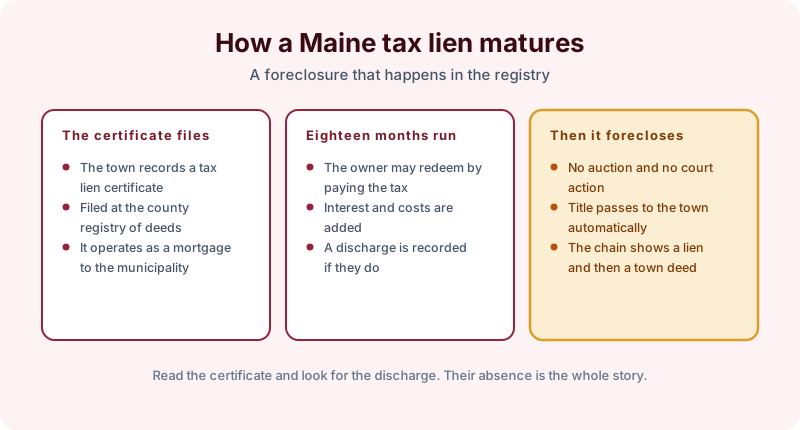
If the redemption period passes without a discharge, the lien forecloses by operation of the statute and title passes to the municipality. There is a notice step, since the treasurer has to notify the owner and the record mortgage holders inside a window shortly before the foreclosure date, but there is no auction and no court proceeding. What a searcher sees in the chain is a certificate, then silence, then a deed out from the town years later. The absence of the discharge is the event, and it is easy to read past.
Towns do not always take possession immediately, and some sell back to the former owner afterward, producing chains that look stranger than they are.
Which office holds what
The Cumberland County Registry of Deeds holds deeds, mortgages and discharges, the municipal tax lien certificates described above, and the easements, subdivision plans and restrictions recorded against land in the county.
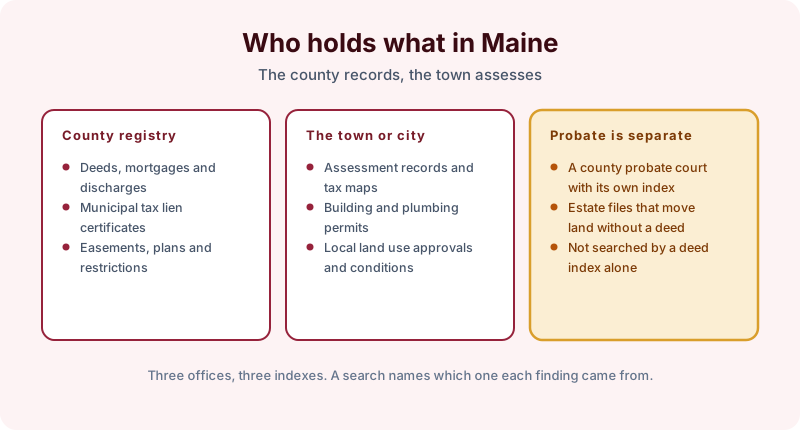
The town or city office holds assessment records and tax maps, building and plumbing permits, and local land use approvals with whatever conditions were attached to them. Maine's towns do a great deal of the governing, and a parcel's permitted use is a municipal question rather than a county one.
Probate sits in a third place. Cumberland County Probate Court keeps its own index, and estate proceedings move real property without a deed being recorded in the registry at all. A chain that appears to stop at a death frequently continues in the probate file.
What the coast adds to a chain
Cumberland County's shoreline runs from Scarborough up through Portland and out along the Casco Bay islands, and waterfront chains here carry their own recurring questions. Maine follows the colonial ordinance rule, under which a shorefront owner's title commonly extends to the low water mark subject to public rights of fishing, fowling and navigation, which is a narrower public reservation than most states apply and a wider private holding.
Island parcels add access. A deeded right of way to a landing, a share in a private wharf, or a ferry easement can be the only legal access a lot has, and those rights are recorded instruments like any other. Conservation restrictions are also unusually common across the county, held by land trusts and by the state, and they run with the land permanently.
What a Cumberland County search covers
We search the registry index by owner name and by legal description across the term you need, and we return the recorded instruments with book, page and recording date. For a coastal parcel that usually means paying particular attention to shore frontage descriptions, rights of way to the water, and the conservation restrictions that are common across the county.
Give us the parcel identification, the owner names including prior owners where you have them, and the town, because the municipal side of the question is answered locally rather than at the registry.
A records search reports what was recorded in the office searched over the term searched, with copies of the instruments found. It is not title insurance and it is not an opinion on who holds title today. Recording practice varies, statutes are amended, an empty result means nothing was found rather than that nothing exists, and the effect of a particular tax lien certificate is a question for an attorney licensed in Maine.