

Searching Davidson County Property Records
Davidson County is Nashville, and since 1963 the two have been a single metropolitan government rather than a city sitting inside a county. For anybody searching property records that consolidation is genuinely helpful, because it removes a layer of separate municipal filings that complicates work in most large counties.
It does not remove everything, and the parts it leaves behind are the ones worth knowing before you order.
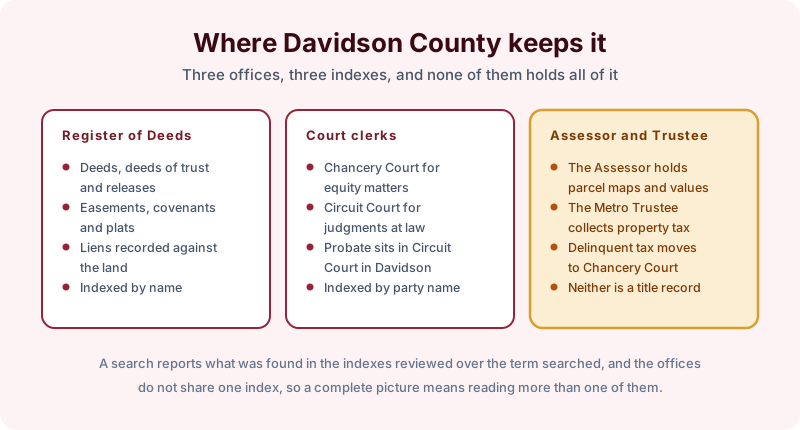
Three offices, three indexes
The Davidson County Register of Deeds holds the land records. Deeds, deeds of trust and their releases, easements, restrictive covenants, plats and liens recorded against real property all sit there, indexed by the names of the parties. That office is where a chain of title is read.
Court filings sit elsewhere. Chancery Court handles equity matters, which in Tennessee includes delinquent property tax suits, foreclosure disputes and quiet title actions. Circuit Court handles judgments at law, and in Davidson County the probate docket is a division of Circuit Court rather than a separate probate court. Both are indexed by party name and neither shares an index with the Register.
Parcel and tax information is a third place again. The Assessor of Property maintains parcel maps, ownership as the county understands it and assessed values. The Metro Trustee collects the property tax. Both are useful for identifying a parcel and neither is a title record, because an assessor updates from a deed rather than the other way around.
What consolidation changes, and what it does not
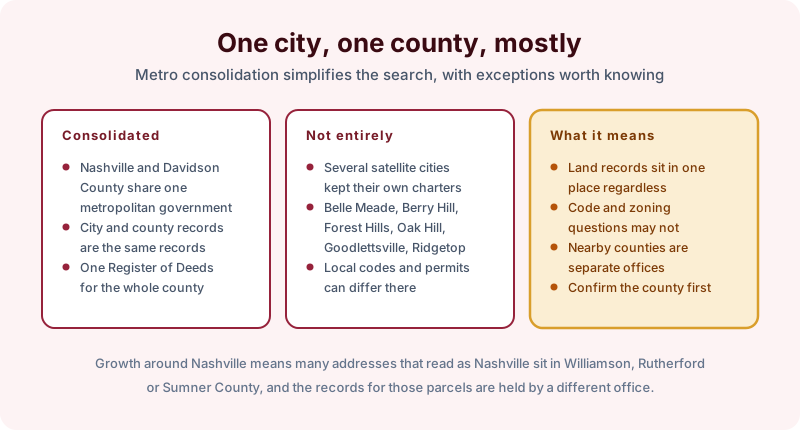
Metro government means the city and the county are one entity, so a single Register of Deeds covers the whole county and there is no separate municipal recording office to check.
Six satellite cities kept their own charters through consolidation. Belle Meade, Berry Hill, Forest Hills, Oak Hill, Goodlettsville and Ridgetop all sit inside or across the county line and run their own local government to varying degrees. Land records for property in them are still with the Register, but codes, permits and some local charges are handled locally, which matters when the question is about use rather than ownership.
The larger trap is the address. Nashville has grown past its county line, and a great many properties with Nashville mailing addresses are in Williamson, Rutherford, Sumner or Wilson County. Those are separate offices with separate indexes, and a search ordered against the wrong county comes back clean on somebody else’s land. Confirm the county before anything is ordered.
What a Davidson County search covers
- The chain of title, read back over the term you specify, with the recorded instruments attached rather than summarized.
- Deeds of trust and releases. Tennessee uses deeds of trust rather than mortgages, and a trustee holds title as security until the debt is paid.
- Liens and judgments of record, including tax liens, mechanics and materialmen’s liens and judgments docketed against the owner.
- Easements, covenants and plat restrictions that run with the land, which in older Nashville neighborhoods can be considerably older than anybody expects.
- Delinquent tax status, and where a tax suit has been filed, the Chancery Court case behind it.
What the record will not tell you
An instrument that was never recorded is not in the index, and under Tennessee law an unrecorded conveyance can still be good between the parties while being void as to creditors and purchasers without notice. Whether that applies in a given situation is a legal question for counsel.
Boundaries are another limit. A legal description is not a survey and a search does not locate anything on the ground. Neither does it report the condition of the building, who is occupying it, or whether a permit was pulled for the work somebody did in the basement.
Ordering a Davidson County search
Supply the street address, the parcel identification number from the Assessor if you have it, and every name the property has been held in, including trusts and entities. Say whether the chain runs through an estate, a foreclosure or a tax sale, and how far back you need the search to reach.
A title search reports what was recorded and indexed in the offices searched, as of the day the work was done. It is not proof that nothing else exists, it is not a title insurance commitment and it is not a legal opinion. Our report names the indexes reviewed and attaches copies of what was found.