

Searching East Baton Rouge Property Records
Louisiana is the one state where a property records search starts with different words. There are no counties, there is no recorder of deeds, and the land itself is immovable property rather than real property. In East Baton Rouge Parish, as everywhere in the state, the office that holds the record is the Clerk of Court, and the structure underneath it comes from civil law rather than from the common law system the rest of the country uses.
None of that makes a search harder. It does mean that asking for a grantor index by name will get you a polite correction, and that a searcher who does not know the vocabulary will ask the wrong office for the wrong thing.
Two Indices, Not One
The first thing to understand is that conveyances and encumbrances are kept apart. The conveyance records cover sales, donations and exchanges of immovable property, and they are indexed by vendor and vendee rather than grantor and grantee. The mortgage records cover mortgages, liens, judgments and what Louisiana calls privileges, indexed by mortgagor and mortgagee.
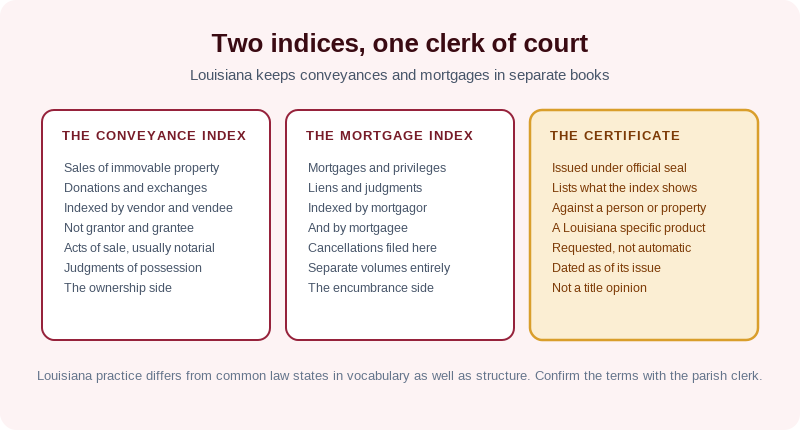
They are separate books and separate searches. A clean conveyance search tells you about ownership and says nothing about what encumbers it, which is why a full picture in East Baton Rouge means working both sides.
The parish also issues something most states do not have, a mortgage certificate under official seal reporting what the index shows against a named person or a named property. It is requested rather than automatic, it is dated as of the day it issues, and it is not a title opinion.
How a Document Reaches the Record
Recording happens in the parish where the property sits, and that is a requirement rather than a convention. The Clerk's recording department takes in notarial acts, assigns each instrument an identification number, and applies a stamp carrying the date and the time of recordation. The time stamp matters more than people expect, because on a same day filing it is the only thing in the record establishing which instrument came first.
Louisiana documents also look different. An ordinary sale is frequently an act of sale passed before a notary with witnesses, and the notary's role is substantially larger here than in most states. Successions, judgments of possession and recorded servitudes all turn up in the conveyance books alongside the sales.
Which Office Answers Which Question
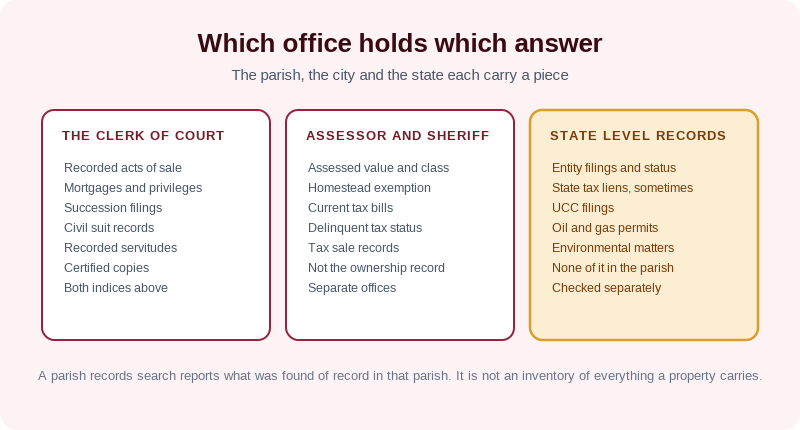
The Clerk holds the recorded instruments, the civil suit records, certified copies and both indices. Assessed value, homestead exemption, current bills and delinquent tax status sit with the assessor and the sheriff, who handles tax collection in Louisiana. Entity filings, UCC records and state level matters are not in the parish at all.
That division is ordinary, and it is the reason a search has to be scoped by question rather than by office. Knowing that the sheriff collects taxes, rather than a county treasurer, saves a wasted request.
What a Long Chain Looks Like
East Baton Rouge grew outward from the river in waves, and a chain here can run through several of them. Land that was agricultural into the middle of the last century was subdivided through the postwar decades, annexed in pieces by the city, and in a few areas consolidated again for commercial development. Each of those steps left instruments behind, and the descriptions change shape as you go back.
Older descriptions frequently reference a plat or map of survey recorded separately, and the drawing is where the dimensions and the servitudes actually live. Reading the deed without pulling the map leaves part of the burden unaccounted for. That is true in every state, and it bites harder on a chain that crosses from rural tracts into platted lots partway through.
Ordering a Search Here
Supply the municipal address, the parish, the assessment or parcel number, and every name the property may have been held under, including entity names and former names. On older chains, include married names and any spelling variants, since the indices are name driven on both sides.
A records search reports what was found of record in the parish searched, over the term searched. It does not establish who owns the property today, and recording practice varies across Louisiana's sixty four parishes, so a local practice in East Baton Rouge is not a statement about the state. Questions of ownership and of what an instrument accomplished are legal conclusions for an attorney licensed in Louisiana.