

Searching Erie County Property Records
Property records for Buffalo and the rest of Erie County, New York are recorded with the Erie County Clerk, and New York puts something in that office that most states keep elsewhere. The judgment docket sits alongside the land records, which makes one part of a title search unusually straightforward and makes the name work that feeds it unusually important.
The tax picture runs the other way. It is spread across more levying bodies than almost any other state, and a parcel can owe four different authorities at once.
Where the Records Are Held
Three offices between them hold what a search needs, and they are organized differently from the county clerk model most states use.
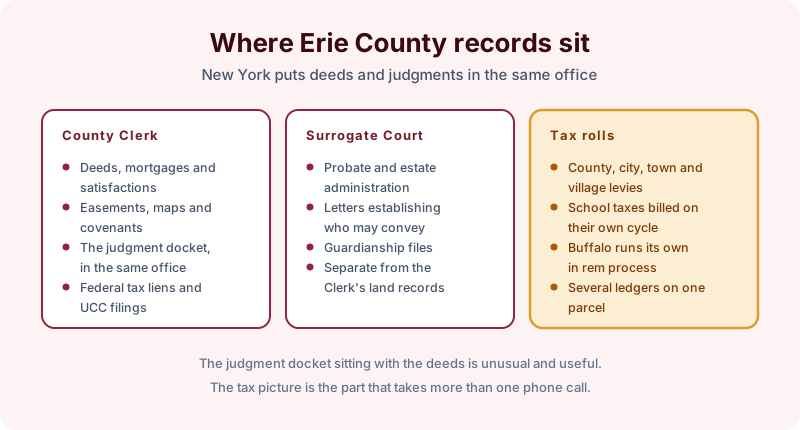
The Erie County Clerk records deeds, mortgages, satisfactions, easements, filed maps and covenants, and also maintains the judgment docket, federal tax lien filings and UCC records. Having the land and judgment records in one office is a genuine convenience, and it is not the arrangement in most of the country.
Surrogate Court handles probate and estate administration, and where an estate is in the chain the letters issued by that court are what establish who could lawfully convey. Those files are separate from the Clerk's land records and have to be requested on their own.
The tax rolls are the complicated part. County, city, town and village levies coexist, school taxes run on their own billing cycle, and the City of Buffalo operates its own in rem foreclosure process for delinquent property. One parcel, several ledgers, several offices.
How a Judgment Reaches the Land
Because judgments are docketed with the County Clerk, this part of a New York search is well defined, and the failures are predictable.
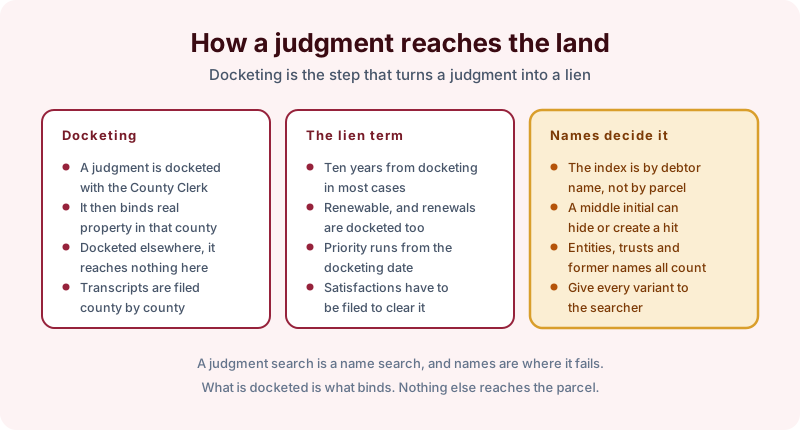
Docketing is the operative step. A money judgment binds real property in a county once it is docketed with that county's clerk, and a judgment docketed in another county reaches nothing in Erie County until a transcript is filed here.
The lien generally runs ten years from docketing, it can be renewed, and priority runs from the docketing date rather than from the date of the underlying decision. Satisfactions have to be filed to clear the record, and unfiled satisfactions are one of the more common cleanup items on an older parcel.
What decides whether a search finds any of it is the name. The docket is indexed by debtor name, not by parcel, so a middle initial, a maiden name, a trade name or a dissolved entity can hide a judgment that is plainly there. Give the searcher every variant you know rather than the name on the current deed alone.
What Makes an Erie County Search Different
- New York is a lien theory state and forecloses judicially, so a foreclosure in the chain means a court file to read rather than a trustee's deed to accept.
- Buffalo housing stock is old. Chains on the East Side and in the older streetcar neighborhoods run back to the nineteenth century, with subdivision restrictions and party wall agreements still recorded.
- Abstracts are the local habit. Attorneys here often work from a continued abstract of title rather than a fresh search, and a gap in that continuation is worth closing rather than assuming.
- Land bank property is common. Parcels conveyed out of the Erie County Land Bank or the city carry their own conditions, and those come through the deed.
Ordering an Erie County Search
Send us the property address, the SBL or parcel identifier if you have it, and every name the property may be held under, including prior names and entity variants. Say whether the parcel is inside the City of Buffalo, since that changes which tax and code records apply.
A current owner search with judgment and lien searches covers most purchases and refinances. Where an estate, a foreclosure or a land bank conveyance sits in the chain, a full chain of title search is the more reliable scope.
A title search reports what was recorded and found in the indexes reviewed, as of the day the work was done. It does not establish amounts owed, which come from the taxing authority, and it is not a legal opinion on what any recorded instrument means.