

Searching Fairfax County Land Records
Fairfax County is one of the largest jurisdictions in Virginia by population and by transaction volume, and a property search here runs into two things that catch out searchers from other states. Virginia keeps land records in the courthouse rather than in a recorder's office, and a Fairfax mailing address does not reliably tell you which courthouse.
Both are easy to handle once you know about them. Both waste a week if you do not.
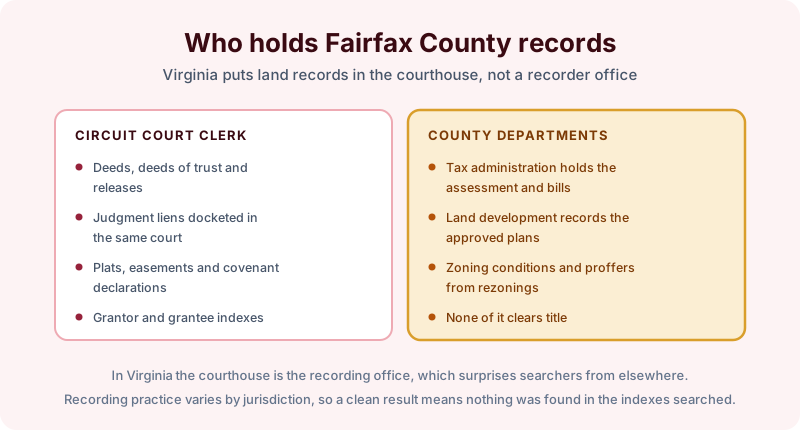
The Circuit Court Clerk is the recording office
Deeds, deeds of trust, releases, plats, easements, and covenant declarations are all recorded with the Clerk of the Circuit Court for Fairfax County, and indexed by grantor and grantee name. There is no separate county recorder, and asking for one produces a confused conversation.
Keeping land records in the courthouse has one genuine advantage. Judgment liens are docketed in the same court, so the money judgments that attach to real estate sit alongside the instruments they encumber rather than in a different building under a different index.
Virginia uses deeds of trust
Residential and commercial financing in Virginia is secured by a deed of trust rather than a mortgage. Legal title goes to a trustee, who holds it for the lender until the debt is satisfied, and a release is recorded when it is.
For a search, the mechanics are familiar. What differs is enforcement, because a default can proceed through a trustee sale rather than through a court foreclosure, and that process moves quickly. Substitutions of trustee are themselves recorded instruments and belong in the chain.
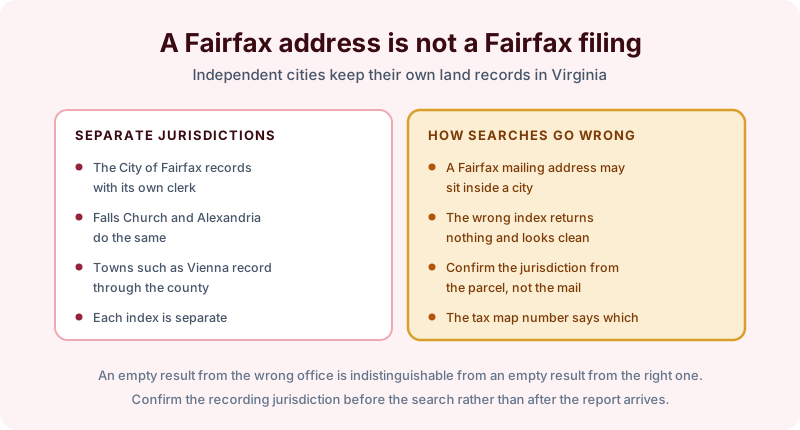
Independent cities keep their own records
Virginia has independent cities that are not part of any county. The City of Fairfax is geographically surrounded by Fairfax County and records with its own Circuit Court Clerk. Falls Church does the same, and Alexandria and Arlington are separate jurisdictions again.
The trap is the mailing address. A property addressed Fairfax, Virginia may be recorded in the county or in the city, and searching the wrong index returns nothing at all. An empty result from the wrong office looks exactly like a clean report from the right one. Towns such as Vienna and Herndon are inside the county and record through the county clerk, which adds another distinction to keep straight.
Confirm the jurisdiction from the parcel identifier rather than from the mail. The tax map number tells you which office holds the record.
This matters more in Northern Virginia than almost anywhere else in the country, because the jurisdictions are small, densely packed, and interleaved. A search of three neighboring properties can require three separate clerks, and nothing about the addresses signals it.
What else turns up in Fairfax
Much of the county is governed by recorded homeowner or condominium association declarations, and those carry assessment obligations and architectural restrictions that run with the land. Rezonings frequently come with proffers, which are conditions the developer accepted and which bind the property afterward.
There is also a lot of recorded easement. Utility corridors, road dedications to the Virginia Department of Transportation, stormwater management areas, and pedestrian access easements are common on suburban lots and are drawn on plats rather than described in the deed.
Reading the plat alongside the deed is therefore not optional here. A lot can be entirely conforming on paper and still have most of its rear yard committed to a drainage easement that no deed language mentions.
Ordering a Fairfax County search
Supply the street address, the tax map number if you have it, and the current owner name. Say whether the property is inside the City of Fairfax or the county, or ask us to establish it, because that determination decides which clerk gets searched.
A search documents what has been recorded and indexed as of the date it is performed. Recording practice varies from one Virginia jurisdiction to the next, and questions about the effect of a proffer, a covenant, or a trustee sale belong to an attorney licensed in Virginia.