

Searching Hamilton County Property Records
Hamilton County is Cincinnati and the townships around it, sitting in the corner of Ohio between two rivers. The filing offices work the way they do everywhere else in the state, and the descriptions in the deeds do not, because this ground was surveyed and sold before the national system had settled into its final shape.
That history is the thing that makes a search here different.
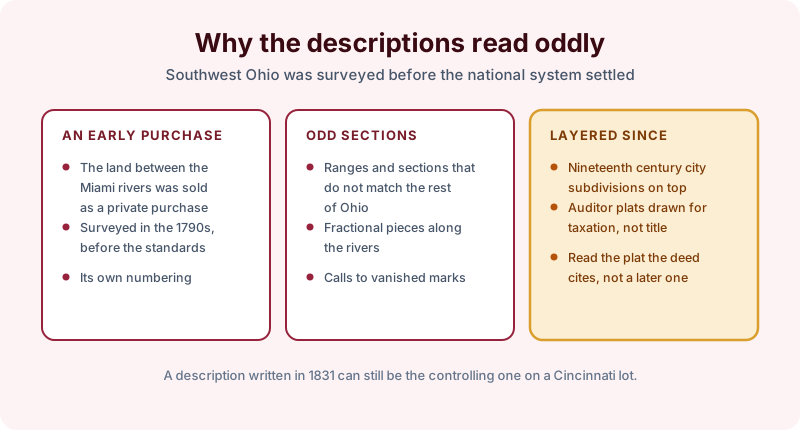
Why the legal descriptions read oddly
The land between the Great Miami and Little Miami rivers was sold as a private purchase in the 1790s and surveyed under its own scheme, with ranges, townships and sections numbered on a pattern that does not line up with the rest of Ohio. Parcels along the rivers were left fractional where the survey ran out of room.
The practical consequence is that an old description here can call for monuments that stopped existing a century ago, reference a range and section that mean something locally and nothing in a state index, and describe a piece whose acreage never matched a standard section in the first place.
Layered on top of that is everything Cincinnati built. Nineteenth century city subdivisions, auditor plats drawn for taxation rather than for title, and modern replats. A deed citing one plat and a tax record citing another is ordinary here, and establishing which plat controls is a real step rather than a formality.
The filing sequence itself follows the Ohio rule. A deed is presented to the county auditor for transfer before the recorder will accept it, so an instrument that never completed the auditor step never reached the land records at all. The auditor also holds the parcel numbers and the tax position, and the clerk of courts holds judgments and civil cases on an index organized by party name.
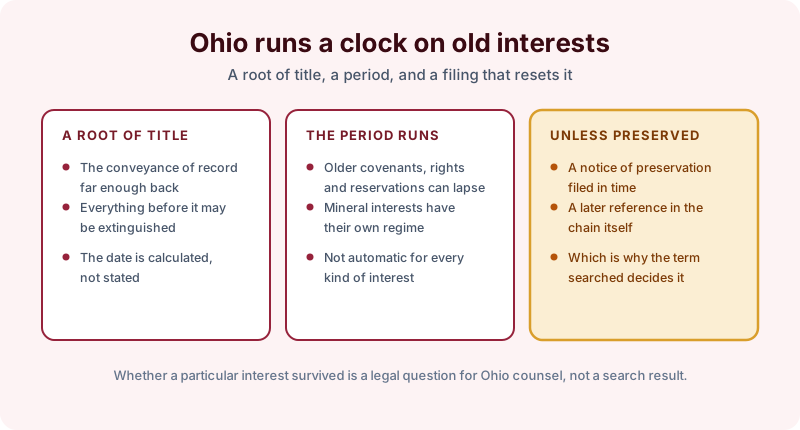
Ohio runs a clock on older interests
Ohio has a marketable title statute, and it changes what an old instrument is worth. The idea is that a conveyance far enough back in the chain becomes a root of title, and interests predating it can be extinguished unless somebody acted to keep them alive. Severed mineral interests have their own separate regime with its own steps.
An interest survives if a notice of preservation was filed in time, or if the chain itself keeps referring to it. So two neighboring lots can carry the same 1890s restriction, and on one of them it may be gone while on the other it is still enforceable, purely because of what was filed afterward.
None of that is something a records search decides. Whether a given covenant, reservation or easement survived is a legal question for Ohio counsel, and the search supplies the instruments and the dates the analysis runs on. What it does mean in practice is that the term searched changes the answer, because a short search will not reach the root at all.
What the chain tends to carry here
Expect long chains. Cincinnati was a major city when much of the country was still frontier, so a parcel in the basin can carry conveyances back into the 1820s, and the older instruments are handwritten, abbreviated, and indexed under spellings that drifted.
Expect old restrictions too. Hillside neighborhoods carry recorded slope, drainage and party wall arrangements, and the river bottoms carry flood easements and railroad rights of way that have outlived the railroads that took them.
Ordering a Hamilton County search
Supply the street address, the auditor's parcel number, and every name the property has been held in. Say whether the chain runs through an estate, a foreclosure or a land contract, because each of those puts part of the answer in a court file rather than in the recorder's books.
A title search reports what was recorded and indexed in the offices searched, as of the day the work was done. It is not proof that nothing else exists, it is not a title insurance commitment, and it is not a legal opinion. Recording and indexing practice varies from one Ohio county to the next, so our report names the indexes reviewed and attaches copies of what was found.