

Searching Hinds County Property Records
Hinds County holds Jackson, the state capital, and the largest concentration of property records in Mississippi. It also carries a structural quirk that catches searchers from out of state more reliably than anything else in the county. Hinds is split into two judicial districts, each with its own courthouse, its own chancery clerk office and its own set of land records, and a search run in the wrong one comes back clean.
Two Districts, Two Sets of Books
The First Judicial District is seated in Jackson and covers the city and the eastern part of the county. The Second Judicial District is seated in Raymond and covers the western part, including Raymond, Edwards, Bolton and Utica. Each district maintains its own deed books and its own grantor and grantee indexes.
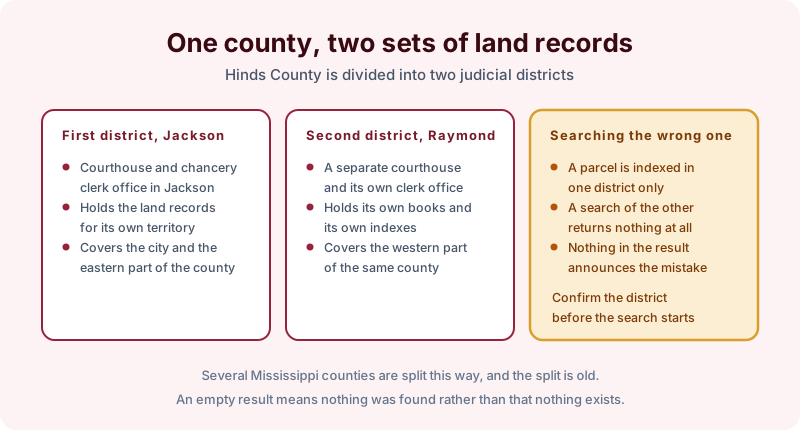
A parcel is indexed in one district only. Search the other and you get nothing, and nothing in the result announces the mistake, because an empty index looks the same whether a property has no filings or simply lives somewhere else. Hinds is not alone in this. Several Mississippi counties are divided the same way, and the divisions are old enough that they predate most of the records in them.
So the first step on any Hinds County property is to settle which district the parcel sits in, by address or by legal description, before anybody starts pulling index pages.
Which Clerk Holds Which Record
Mississippi splits the county record between two elected clerks, and the split is not intuitive if you are used to a single recorder.
The chancery clerk is the land records office. Deeds, deeds of trust, assignments and cancellations, plats, easements and recorded covenants all live there, along with wills and estate matters, since chancery court handles land and equity business in Mississippi.
The circuit clerk holds the judgment roll. A civil judgment reaches the land through enrollment on that roll rather than through the deed books, which means a search that looks only at the chancery records can miss a lien that attached years ago. Suits that may ripen into a claim against the property sit there as well.
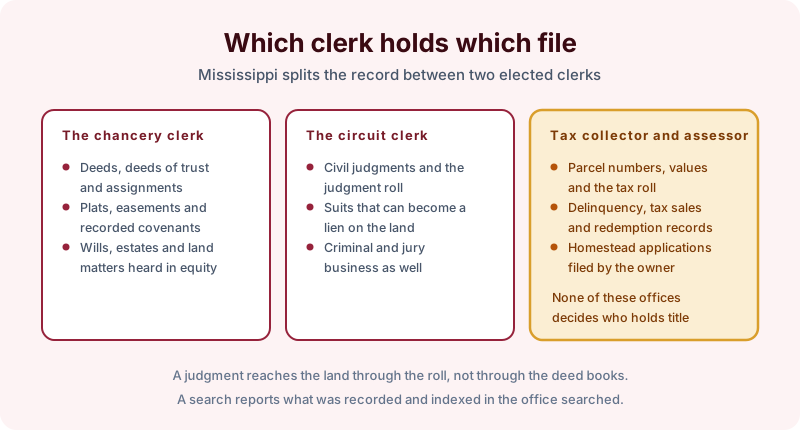
The tax assessor and tax collector hold the parcel numbers, the values, the tax roll, the delinquency and tax sale records, and homestead applications. Useful, and not a statement about ownership.
What a Search Covers Here
A search of the Hinds County land records reports what was recorded and indexed in the district searched, over the period searched, with copies of the instruments found. On a Mississippi property that normally means the chain of title, the deeds of trust and their cancellations, the easements and covenants of record, the plat where one governs, and the judgment roll run against the owner names.
Scope the order by giving the address, the parcel number and the owner names, and say if you already know the district. If you are not sure which district the parcel falls in, give us the address and we will settle it before the search begins rather than after.
Tax sales deserve their own line here. Mississippi sells delinquent taxes at an annual sale, and the purchaser does not get a deed straight away. A redemption period runs, and only if the property goes unredeemed does a tax deed issue from the chancery clerk. A search run partway through that window shows a sale on the record with ownership unchanged, which is accurate and easy to misread.
What It Will Not Settle
It does not establish who owns the property today, which is a legal conclusion rather than a search result. It does not report zoning, permits, code enforcement or the condition of a building. It is not a survey and it does not place a boundary on the ground. And indexing practice varies county by county and district by district, so an empty result means nothing was found rather than that nothing exists.