

Searching Honolulu Property Records
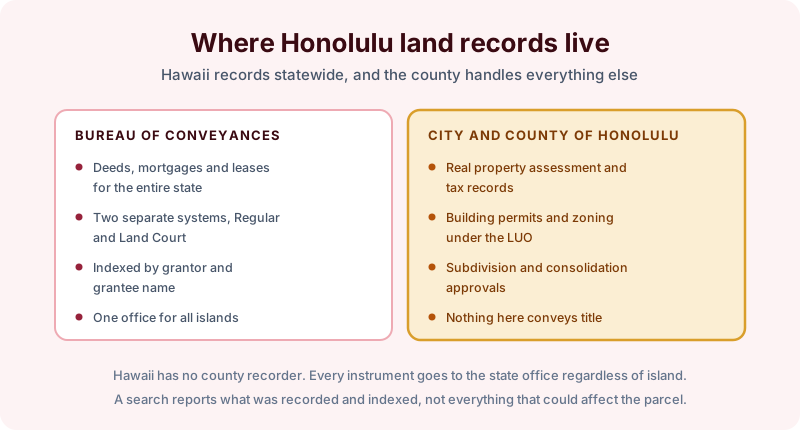
Honolulu is one of the few places in the United States where a property searcher cannot start at the county recorder, because there is not one. Hawaii records land instruments statewide, through a single office, and the City and County of Honolulu handles everything else about a parcel except the documents that convey it.
That is the first surprise. The second is that Hawaii runs two parallel systems of title, and which one your parcel sits in changes what a search can look at.
The Bureau of Conveyances holds everything
The Bureau of Conveyances, part of the state Department of Land and Natural Resources, is the recording office for all four Hawaii counties. Deeds, mortgages, leases, liens, and releases for a parcel in Waianae, in Hilo, or on Molokai all go to the same building in Honolulu.
Instruments are indexed by grantor and grantee name, so a search runs on names rather than on the parcel, exactly as it does on the mainland. The tax map key, Hawaii's parcel identifier, is how you confirm you are looking at the right land, but it is not how the index is organized.
Regular System and Land Court are different animals
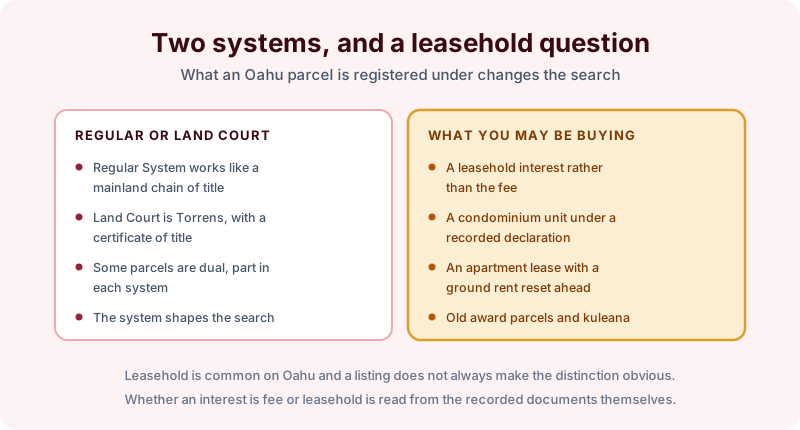
Hawaii kept the Torrens system that most states abandoned. Land registered with the Land Court has a certificate of title, and that certificate is conclusive as to what burdens the land. Everything affecting a registered parcel is noted on the certificate, so the search is a matter of reading it rather than reconstructing a chain.
The Regular System works the way a mainland searcher expects. You trace conveyances backward through the grantor and grantee indexes and read each instrument in turn.
A meaningful share of Oahu land is registered, some parcels are partly in each system, and a search built for one is not a search of the other. Establishing which system governs is the first step, not a detail.
The practical difference shows up in what gets delivered. On a Regular System parcel the report is a sequence of instruments read in order. On a registered parcel it is the certificate plus the documents noted on it, and a transfer produces a new certificate rather than simply another deed in a chain.
Leasehold is not unusual here
On Oahu, a great many residences sit on leasehold land, where the buyer acquires a long-term lease rather than the fee. Large landowners, trusts, and estates have historically retained the fee and leased the surface for decades at a time.
The practical consequences are real. A ground rent can reset at a stated date, the lease has a term that eventually ends, and a lender treats a leasehold as a different kind of collateral. Condominium units add another layer, because the declaration and its amendments govern the unit and are recorded separately from the deed.
What the county does hold
The City and County of Honolulu handles real property assessment and taxation, building permits, zoning under the Land Use Ordinance, and subdivision approvals. Useful context for a purchase, and none of it conveys or clears title.
Older parcels can carry descriptions that trace to Land Commission Awards and kuleana grants from the mid nineteenth century. Those descriptions are legitimate and they are not always easy to reconcile with a modern survey, which is a question for a licensed surveyor rather than an abstractor.
Ordering a Honolulu search
Supply the tax map key if you have it, the street address, and the current owner name. Say whether you know the parcel to be Land Court or Regular System, and if you do not, that is part of what the search establishes. For a condominium, the unit and project name matter as much as the address.
A title search reports what has been recorded and indexed as of the date it is run. It is not an inventory of everything that could affect the land, and questions about the effect of a Land Court certificate or a lease term belong to an attorney licensed in Hawaii.