
Searching Kanawha County Property Records
Property records for Charleston and the rest of Kanawha County, West Virginia are recorded with the Clerk of the County Commission, which is the title West Virginia gives to the office other states call the recorder or the register of deeds. The name matters less than the division of labor around it, because three separate offices hold pieces of what a search needs and the one that decides the hardest questions is not in the county at all.
The rest of the mechanics are conventional. Deeds of trust secure the loans, foreclosure runs through a trustee rather than a court, and a transfer tax is collected at recording. What is not conventional is what happens to land the tax system loses track of.
Where the Records Are Held
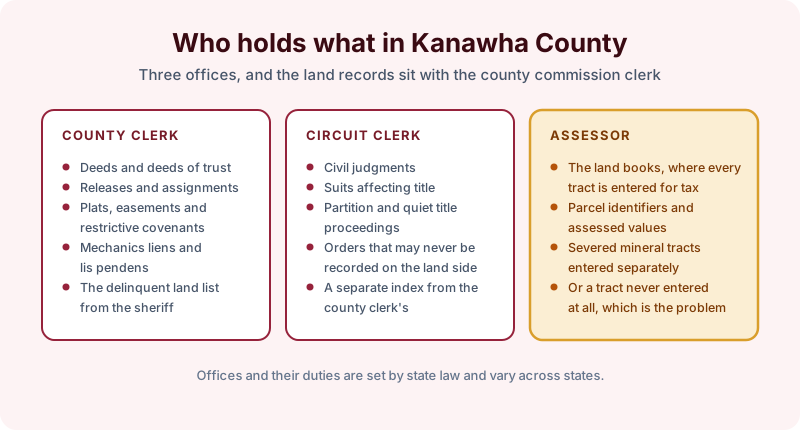
The county clerk records deeds, deeds of trust, releases and assignments, plats, easements, restrictive covenants, mechanics liens and lis pendens, and keeps the delinquent land list the sheriff delivers each year. That office is the first stop on any search and the only one most searches reach.
The circuit clerk holds civil judgments, suits affecting title, partition and quiet title proceedings, and orders that frequently never get recorded on the land side. It is a separate index, and a judgment that has not been docketed against the land will not appear in the county clerk's books.
The assessor keeps the land books, which is where every tract is entered for taxation. In West Virginia that office matters more than it does elsewhere, because a tract can be missing from the land books entirely, and in a state with a great deal of severed mineral ownership that happens more than you would expect.
What Makes Kanawha County Specific
Kanawha is the state's most populous county and holds the capital, which means a deeper commercial record than most of West Virginia and a correspondingly deeper judgment docket. It also sits in the heart of the chemical and extraction corridor along the river, so industrial parcels, pipeline easements and severed mineral interests turn up routinely in otherwise ordinary residential chains.
That severance is the practical complication. A deed conveying a house in a Charleston neighborhood may say nothing at all about the coal, oil and gas underneath it, because those were sold off in the nineteenth or early twentieth century and have travelled independently ever since. A current owner search answers who owns the surface. It does not answer who owns what is below it.
Delinquent and Nonentered Lands
This is the part of West Virginia practice that surprises searchers from other states. The sheriff collects the property tax. Unpaid tracts go onto a delinquent list, the list goes to the county clerk, and the clerk forwards a copy to the State Auditor, who serves as the state commissioner of delinquent and nonentered lands.
Nonentered land is the stranger category. It is land that was never entered on the land books in the first place, so it was never assessed, never billed and never declared delinquent in the ordinary way. Severed mineral tracts that nobody claimed are the classic example. The statutory process still reaches them.
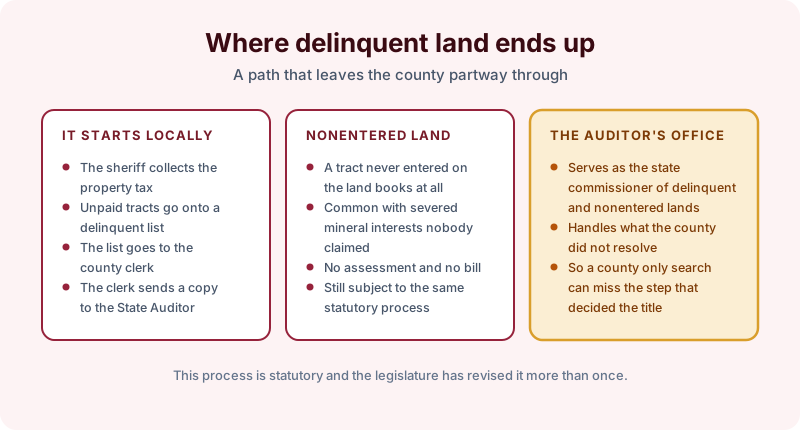
The consequence for a searcher is that a step which may have decided the title took place in an office outside the county. The legislature has revised this process more than once, so the current mechanics are worth confirming against the statute rather than against a summary.
Ordering a Kanawha County Search
Send the address, the parcel identifier from the assessor, the current owner name, and whether minerals are in scope, because that single answer changes the term and the cost more than anything else. Tell us if the parcel is industrial or riverfront, since those chains carry easements and agreements that a residential search would not reach for.
What comes back is what was found of record in the offices searched over the term searched, with copies of the instruments. It is not an opinion on who holds title and it is not title insurance. Recording and indexing practice varies county by county, so an empty result means nothing was found rather than that nothing exists.