

Searching Kent County Property Records
Kent County is Michigan's fourth largest county and the home of Grand Rapids, a city that has spent two decades converting furniture factories into apartments and infill lots into townhomes. Searching property records there is straightforward in form and carries two statutory features that catch outsiders, both of them coming from the county side of the courthouse rather than the state.
The first one changes how a deed gets recorded at all.
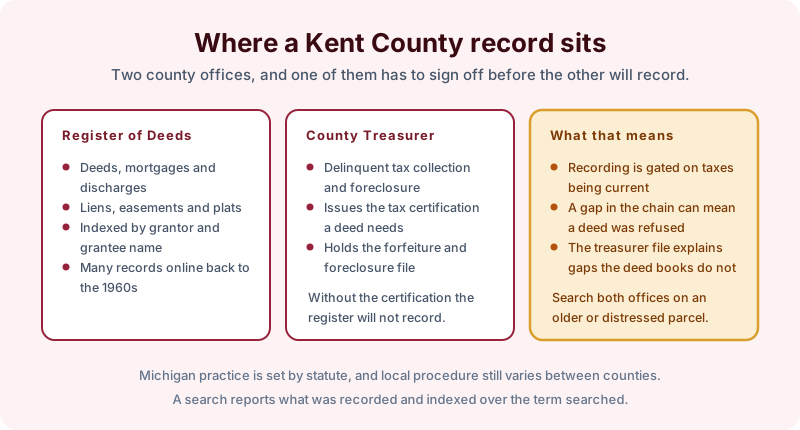
Two offices, and the treasurer goes first
Land records in Kent County are held by the Register of Deeds, which maintains grantor and grantee indexes covering deeds, mortgages, discharges, liens, easements and recorded plats. A good share of the modern record is imaged and searchable online, with the older volumes available at the office.
What makes Michigan different is that a deed conveying property generally cannot be recorded until the County Treasurer certifies that no delinquent taxes are owed on the parcel. The certification is a stamp on the instrument, and without it the register will refuse the filing.
That rule produces a research signal worth knowing. When a chain of title shows a conveyance that was clearly executed but never appears in the index, the explanation is sometimes not a lost deed at all. It is a deed that was presented, refused for want of certification, and never brought back. The treasurer's file will frequently explain a gap that the deed books cannot.
Tax foreclosure is the sharper feature
Michigan's delinquent tax process ends in a circuit court judgment of foreclosure, and the judgment does something stronger than a tax sale in most states. It vests absolute title in the foreclosing governmental unit, which in Kent County is the county treasurer acting as the foreclosing unit.
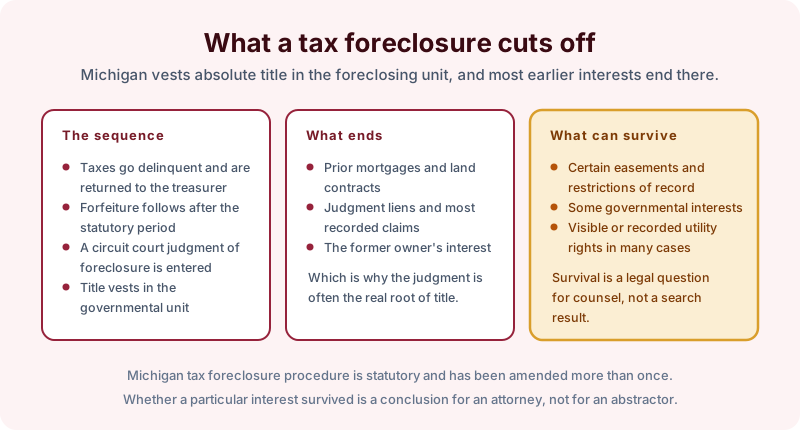
Prior mortgages, land contracts, judgment liens and the former owner's interest generally end at that judgment. Certain easements and restrictions of record, and some governmental interests, can survive it. Which is which is a legal question that belongs to an attorney rather than to an abstractor, and the answer has shifted as the statute has been amended.
For a searcher the practical effect is that the judgment often functions as the root of title. Instruments recorded before it may be historically interesting and legally spent, and a report that lists them without noting the judgment between is describing the parcel misleadingly.
What sits outside the register's office
- Assessing and tax records, held by the city or township assessor rather than the county.
- Zoning, site plan and building files, which are municipal and are not recorded against the parcel.
- Drain district assessments, administered by the county drain commissioner under a statute with no close analogue in most states.
- Brownfield and redevelopment agreements, common on former industrial ground in Grand Rapids and frequently recorded only in part.
Setting the scope
Supply the legal description and the parcel number rather than the street address, because Grand Rapids has renumbered and renamed streets and a mailing address can sit in a different municipality from the one the records follow. Give every owner name across the term, including entity forms, since infill parcels frequently pass through a development LLC that existed for eighteen months.
Ask for a chain that reaches past any tax foreclosure in the history, not merely to it. The judgment is the hinge and you want the instruments on both sides of it.
A search reports the deeds and mortgages, the liens, judgments and lis pendens, and the easements, covenants and plats found of record for the parcel over the term searched, with copies of the instruments. It does not determine whether a particular interest survived a tax foreclosure, does not reach the municipal zoning or building file, and does not report assessing records. Nothing found of record is not proof a parcel is unencumbered, and recording and indexing practice varies by county.