
Searching Laramie County Property Records
Wyoming does not have a recorder of deeds. The county clerk performs that function, and in Laramie County the clerk's real estate and recording office in Cheyenne is where deeds, mortgages, releases, covenants, easements, liens and plats are placed on permanent record. If you are used to asking for the recorder, that is the office you want.
The county also allows the public to research and view recorded documents in that office during business hours at no charge, which is worth knowing before paying for an index subscription you may not need.
What the Clerk Records, and What a Filing Carries
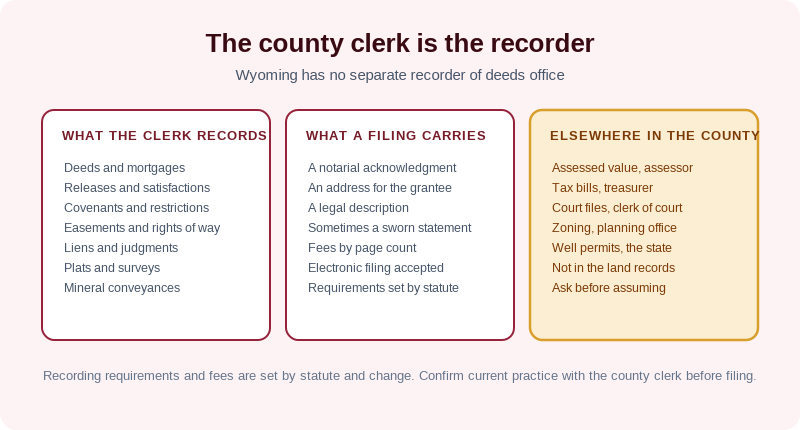
The recorded set is the familiar one. Deeds and mortgages, releases and satisfactions, restrictive covenants, easements and rights of way, liens and judgments, plats and surveys, and mineral conveyances.
Wyoming asks for a little more at the counter than some states do. A transfer instrument needs a proper notarial acknowledgment, and the clerk's instructions call for an address for the grantee at recording. Fees run by page count, and the county accepts electronic recording through several of the common submission services. Requirements are set by statute and do change, so confirming the current ones with the clerk before filing is cheaper than a rejection.
Laramie County also offers a free document alert service, which emails a subscriber whenever something is recorded using their name or against their property. It is a fraud notification tool rather than a search product, and it does not replace one.
Where the Rest of the Answer Lives
Assessed value sits with the assessor, tax bills and delinquency with the treasurer, court files with the clerk of district court, and zoning with the planning office. Well permits and production data are state records rather than county ones. None of that is in the land records, and asking the clerk for it will send you to the right place but not save the trip.
The Mineral Half of a Wyoming Parcel
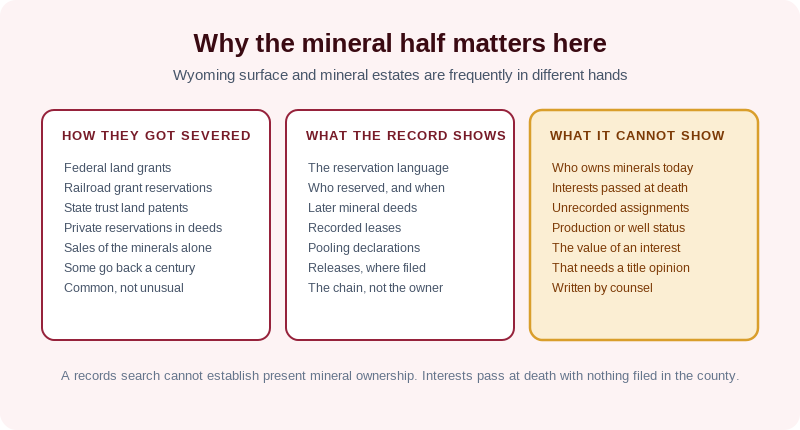
This is the part of a Wyoming search that surprises buyers from elsewhere. Surface and mineral ownership are frequently in different hands, and the severance usually happened a long time ago. Federal land grants, railroad grant reservations, state trust land patents, private reservations written into old deeds, and outright sales of the minerals alone all produced the same result.
What the county record shows is the reservation language, who reserved and when, later mineral deeds, recorded leases, pooling declarations and any releases that were filed. What it cannot show is who owns the minerals today. Interests pass at death with nothing filed in the county, assignments go unrecorded, and the last grantee named in the index is not necessarily the present owner. Present mineral ownership is a conclusion for a mineral title opinion written by counsel, not something a records search establishes.
Reading a Reservation Carefully
Where a reservation turns up in the chain, the exact words decide how much was held back. A reservation of all oil, gas and other minerals reaches further than one naming only oil and gas, and whether something like sand, gravel or coalbed gas falls inside the phrase has been litigated in state after state with different results. The instrument states the language. What that language covers in Wyoming is a legal question.
Fractions compound the problem. A reservation of half the minerals followed decades later by a conveyance of half of what remains leaves a quarter, and chains with three or four such steps are ordinary on older ranch land. Each step has to be read in order, and arithmetic done on the index summary rather than on the instruments is how interests get overstated.
Ordering a Search Here
Supply the street address where there is one, the county, the parcel or account number, and the legal description if you have it. On rural acreage the description is often by section, township and range rather than by lot and block, and that description is what the search actually runs on. Include every name the property may have been held under, including entity names, former names and spelling variants.
A records search reports what was found of record in the county searched, over the term searched. It is not a survey, it does not locate a boundary on the ground, and an empty result does not prove that nothing exists. Recording and indexing practice varies county by county across Wyoming, so what holds in Laramie County is not a statement about the state.