

Searching Milwaukee County Property Records
Milwaukee County is the City of Milwaukee plus eighteen other municipalities, from Wauwatosa and West Allis out to the small lakeshore villages, all sharing one county government. For a property search that arrangement is straightforward at the county level and gets complicated one layer down.
Wisconsin also has three conveyancing habits that catch out-of-state searchers regularly, and none of them announce themselves in an index.
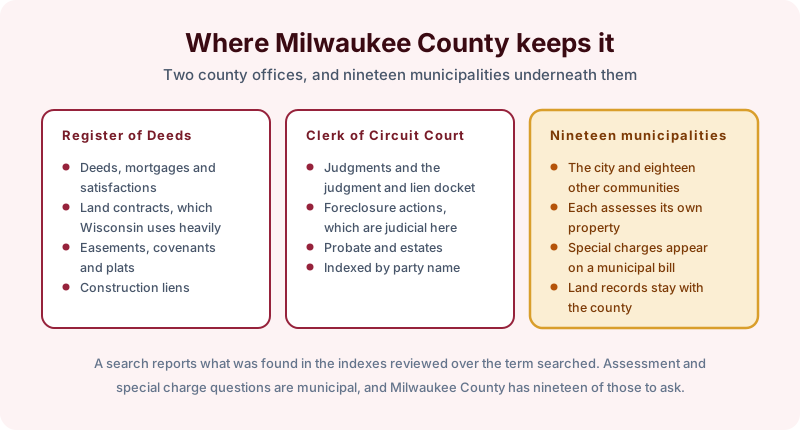
Two county offices hold the record
The Register of Deeds holds the land records. Deeds, mortgages and satisfactions, easements, restrictive covenants, plats, construction liens and land contracts all sit there, indexed by the names of the parties and increasingly by parcel. That office is where a chain of title is read.
The Clerk of Circuit Court holds the rest. Judgments and the judgment and lien docket, foreclosure actions, and probate and estate matters. Wisconsin is a judicial foreclosure state, so a foreclosure in a chain means there is a court file behind it, and that file is a different office with a different index.
Below the county sit the nineteen municipalities. Each assesses its own property and issues its own tax bill, and special charges for things like delinquent utilities or code work are commonly placed on that municipal bill rather than recorded separately. Land records stay with the county regardless of which community a parcel is in, but assessment and special charge questions have to be asked locally.
Three Wisconsin particulars
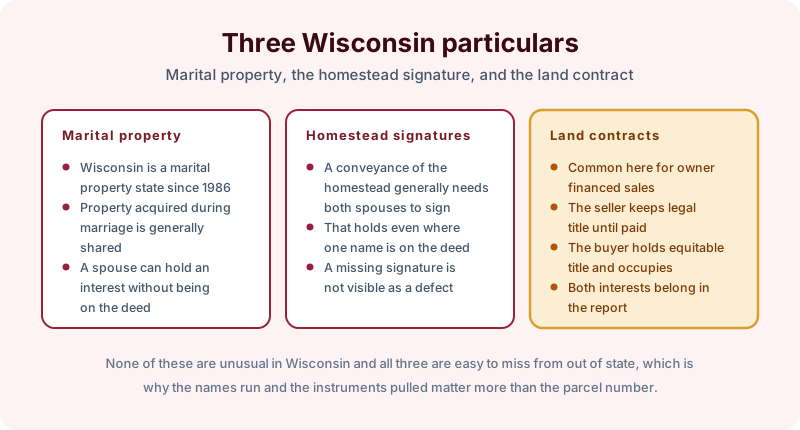
Marital property. Wisconsin adopted the Marital Property Act in 1986 and is generally treated as a community property state. Property acquired during a marriage is ordinarily shared regardless of whose name is on the deed, which means a spouse can hold an interest while appearing nowhere in the chain.
Homestead signatures. A conveyance or mortgage of a homestead generally requires both spouses to sign, even where only one of them is the record owner. A deed signed by one spouse alone is not visible as a defect. It looks like an ordinary instrument, which is why it can sit in a chain for years before anyone examines it.
Land contracts. Wisconsin uses these heavily for owner financed sales. The seller keeps legal title until the contract is paid while the buyer holds equitable title and occupies the property. Both interests are real and both belong in a report, and a search that names only the record owner tells half the story.
What a Milwaukee County search covers
- The chain of title over the term you specify, with the recorded instruments attached rather than summarized.
- Mortgages, satisfactions and assignments, plus any land contract and its assignments.
- Liens and judgments of record, including construction liens, tax liens and judgments docketed against the owner.
- Easements, covenants and plat restrictions, which in the older city neighborhoods can be considerably older than anybody expects.
- Tax status, including whether a parcel has been taken through the city’s in rem tax foreclosure process, which Milwaukee uses at scale.
What the record will not tell you
An instrument that was never recorded is not in the index. Wisconsin gives recording its usual effect, and an unrecorded conveyance can still be good between the parties while being ineffective against a later purchaser without notice. Whether that applies in a given situation is a legal question for counsel.
Boundaries are the other limit. A legal description is not a survey and a search does not locate anything on the ground. Nor does it report the condition of the building, who is occupying it, or whether an open code violation is sitting with the municipality.
Ordering a Milwaukee County search
Supply the street address, the tax key number if you have it, and every name the property has been held in, including trusts, entities and both spouses. Say whether the chain runs through an estate, a foreclosure or a land contract, and how far back the search needs to reach.
A title search reports what was recorded and indexed in the offices searched, as of the day the work was done. It is not proof that nothing else exists, it is not a title insurance commitment and it is not a legal opinion. Our report names the indexes reviewed and attaches copies of what was found.