

Searching Monroe County Property Records
Monroe County is the Florida Keys plus a long stretch of mainland Everglades, and almost all of its private land sits on the islands. Property there is scarce by geography and scarcer by regulation, which is why the land record carries instruments you will not see in a mainland Florida county, alongside the ordinary deeds and mortgages.
Three features of practice here shape what a records search can answer, and none of them is visible on the face of a deed.
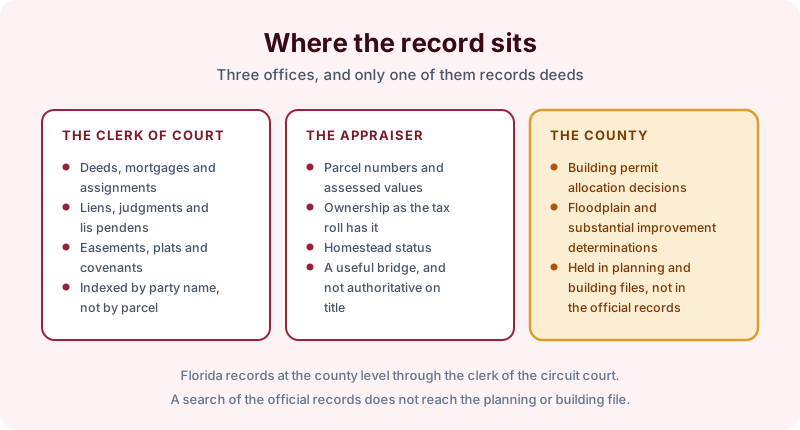
The clerk of the circuit court holds the land record
Florida records at the county level, and in Monroe County the custodian is the Clerk of the Circuit Court and Comptroller. Deeds, mortgages, assignments, satisfactions, liens, judgments, notices of commencement, easements, plats and restrictive covenants all go into one Official Records series, indexed under the names of the parties.
Florida charges documentary stamp tax on a deed, calculated on the consideration, so the amount paid is frequently determinable from the face of the instrument in a way it is not in non-disclosure states. That makes a Florida chain unusually informative about price history, and it also means a deed reciting nominal consideration deserves a second look.
The property appraiser is the other office people reach for, and it is worth being precise about what it is. The appraiser's roll ties an address to a parcel number and names an owner, which is a useful bridge into the index. It is not authoritative on title, and it can lag a recorded conveyance by a full assessment cycle.
A building permit is an allocated thing here
Monroe County and its municipalities operate a permit allocation system for new residential development, a response to hurricane evacuation capacity rather than to zoning in the ordinary sense. The practical consequence for a buyer is that a vacant lot is not necessarily buildable, and that the right to build is governed by a competitive allocation process rather than by the deed.
None of that lives in the Official Records. Allocation standing, scoring and award history sit in county and municipal planning files, and reaching them means a request to the planning department rather than a search of the recorded chain. A clean title report on a vacant Keys lot says nothing at all about whether a house may be built on it.
What the record does carry on a Keys parcel
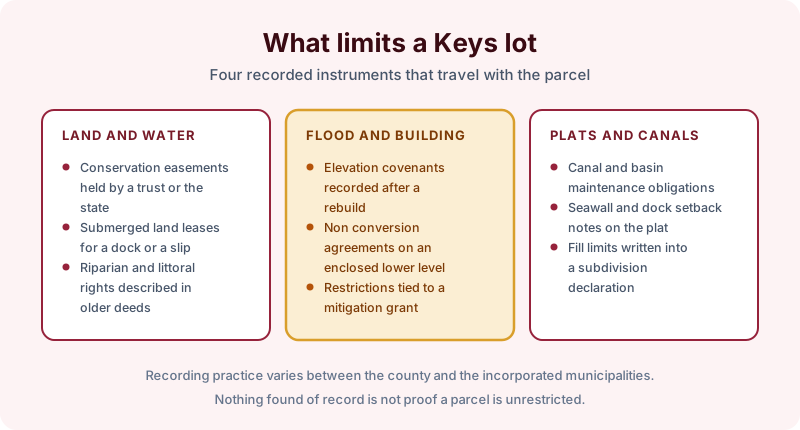
Conservation easements held by the state or by a land trust are common, and so are submerged land leases, because the state holds title to sovereign submerged lands and a dock or a boat slip extending over them is generally held under a lease rather than owned outright. Older deeds frequently describe riparian and littoral rights in terms that no longer match current regulation.
Flood instruments are the category most specific to this county. After a substantial improvement or a rebuild, an elevation covenant or a non-conversion agreement covering an enclosed area below base flood elevation is often recorded, and it binds whoever buys next. So do canal and basin maintenance obligations, seawall and dock setback notes written onto a plat, and fill limits set out in a subdivision declaration.
Five incorporated municipalities, one county index
Key West, Marathon, Key Colony Beach, Layton and Islamorada each run their own planning and building functions, while recording stays with the county clerk. So the recorded chain is in one place and the permit, code enforcement and allocation files are in five or six others, depending on where the parcel sits. Knowing which jurisdiction a lot falls in changes who to ask, and it is not always obvious from the address.
What a Monroe County search covers
A search of the Official Records reports the chain of title, the mortgages and assignments, the liens, judgments and lis pendens, and the easements, covenants and plats found of record against the parcel over the term searched, with copies of the instruments. It does not reach the planning file, the allocation history, the municipal code enforcement ledger or any state agency determination. Nothing found of record is not proof a parcel is unrestricted, and recording and indexing practice varies between counties and over time.