

Searching Montgomery County Property Records
Montgomery County runs from the edge of Washington out to farmland, and the property record reflects both halves of that. It is also a Maryland county, which means the offices are arranged differently from almost anywhere else in the country, and the office most people go looking for does not exist under that name.
Knowing which office answers which question is most of the work.
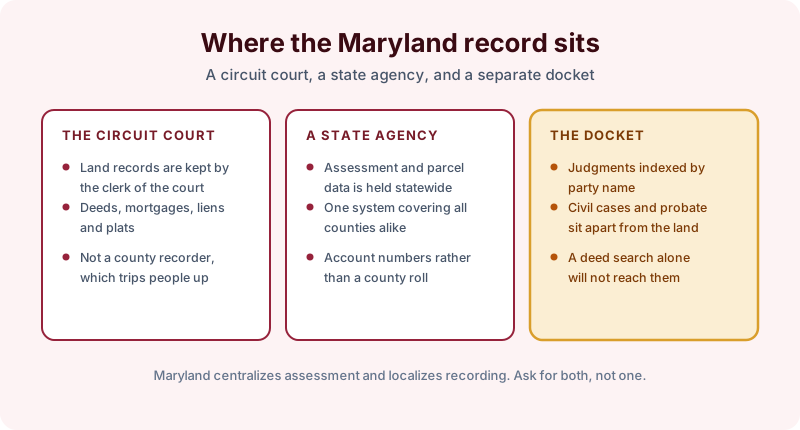
Maryland does not have a county recorder
Land records in Maryland are kept by the clerk of the circuit court for each county, not by a separate recorder of deeds. Deeds, mortgages, liens, easements and plats are filed there and indexed by name. That is the office to ask for, and asking for the recorder will get you a polite redirection.
Assessment and parcel data is the opposite arrangement. Maryland holds it at the state level rather than county by county, in one system covering every jurisdiction alike, with account numbers rather than a county assessor's roll. That is convenient when you are moving between counties and confusing when you expect a local office to have it.
Judgments sit apart from both. They are docketed by party name on the court side, so a search of the land records alone will not reach a judgment against the owner. On a Montgomery County property with an entity owner, that is a separate name search rather than an afterthought.
One further Maryland habit is worth knowing. Recording a deed requires a completed intake sheet and payment of recordation and transfer taxes, and a deed that failed on either point may have been rejected rather than recorded. A gap in a chain here is sometimes an unrecorded instrument sitting in somebody's file.
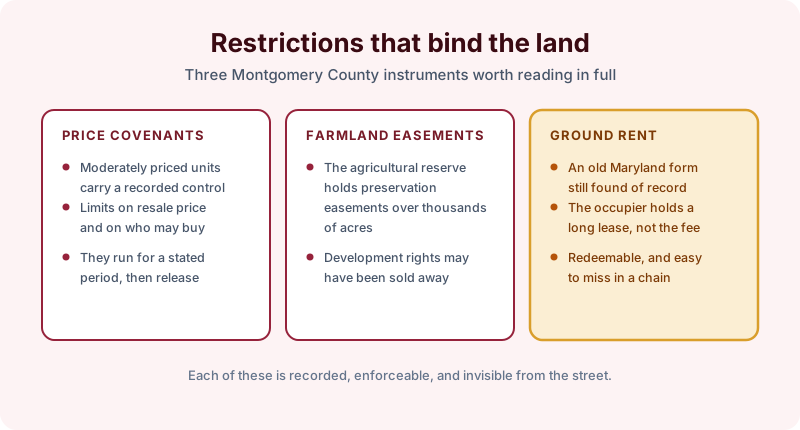
Restrictions that bind the land here
Three recorded instruments turn up in Montgomery County more than most places, and each one limits what an owner can do.
Price controlled housing covenants. The county has required moderately priced units in new development since the 1970s, and those units carry a recorded covenant limiting the resale price and restricting who may buy during a control period. A buyer who does not read it can be surprised twice, once at purchase and once at sale.
Agricultural preservation easements. The county's agricultural reserve covers roughly a third of its land area, and a great deal of it is subject to recorded easements or has had its development rights sold into a transfer program. The ground looks like farmland that could be built on, and frequently cannot be.
Ground rent. This is an old Maryland arrangement in which the occupier holds a long lease and somebody else holds the fee, with a small annual rent running forever. It is associated with Baltimore and it is not confined there. A ground rent is redeemable, it is recorded, and it is easy to read past in a chain of title.
What a search of the chain reaches
A chain search returns the deeds in order with copies attached, along with the mortgages, releases, easements, covenants and plats recorded against the parcel over the term searched. On an older property near the District line, that chain can run back through several subdivisions of a single original tract, and the covenants that still govern the lot were often recorded against the whole of it long before it was divided.
The term matters for that reason. A current owner search shows the present picture and will not reach a declaration recorded in 1968 that still binds the lot. Where restrictions are the question, the longer term is the honest choice.
Ordering a Montgomery County search
Supply the street address, the state assessment account number, and every name the property has been held in, including entity names and any spelling variant. Say whether the chain runs through an estate, a divorce or a foreclosure, because each of those puts part of the answer in a court file rather than in the land records.
A title search reports what was recorded and indexed in the offices searched, as of the day the work was done. It is not proof that nothing else exists, it is not a title insurance commitment, and it is not a legal opinion. Unrecorded agreements, interests that passed at death with nothing filed locally, and boundary questions that need a survey all sit outside it. Recording and indexing practice varies from one Maryland county to the next, so our report names the indexes reviewed and attaches copies of what was found.