

Searching New Haven County Property Records
New Haven County covers twenty-seven towns along the Connecticut shoreline and the hills behind it, and anyone ordering a property search there for the first time usually starts in the wrong place. The instinct is to look for the county recorder. There is not one, and there has not been one anywhere in Connecticut for a very long time.
Knowing that before you order saves a week. Knowing why it is the case saves more than that, because it changes how the search has to be scoped.
The town clerk holds the land records
Connecticut abolished county government in 1960, and the counties that remain are geographic and judicial labels rather than units of administration. The land records moved to, or rather stayed with, the town clerk in each of the state's municipalities.
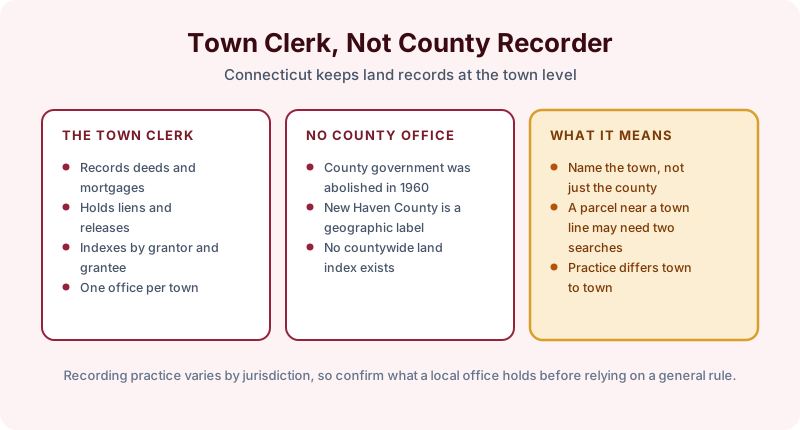
That office records deeds, mortgages, liens, releases and easements, maintains the grantor and grantee indexes, and issues copies. It is a complete land records office in miniature, and New Haven County contains twenty-seven of them operating independently of one another.
The practical consequence is that there is no countywide index to search. A search is a search of a named town, and a request that names only the county is not yet specific enough to run.
What that does to a search near a boundary
Town lines in Connecticut are old and they do not follow modern development patterns. A neighborhood can run continuously across a boundary, a mailing address can carry one town's name while the parcel sits in another, and a larger holding can straddle the line outright.
Where that is a possibility, two searches are needed rather than one, because each clerk's records cover only instruments recorded in that town. A parcel split across a boundary has part of its history in each office, and neither half is complete on its own.
The same caution applies to older chains. Boundaries have been adjusted and towns have been incorporated out of other towns over three centuries, so a conveyance from 1890 may sit in the records of a town that no longer governs the land.
Judgments and the court system
Civil cases in Connecticut run through the Superior Court, organized by judicial district rather than by county, and the court file is where a judgment is entered. That file is not a land record.
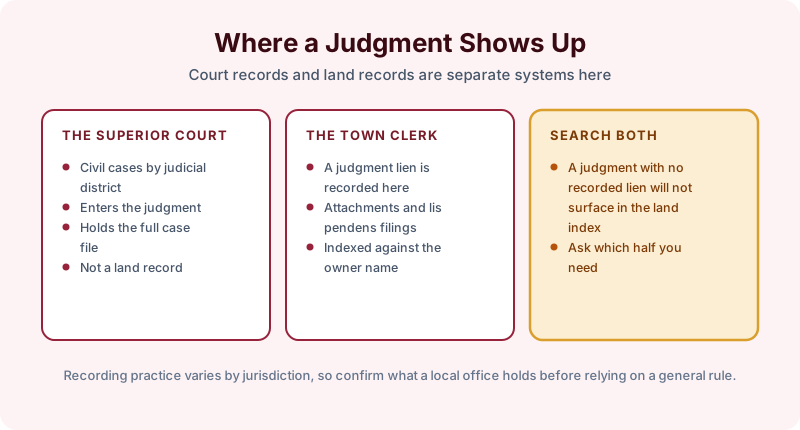
For a judgment to reach the property, a lien has to be recorded with the town clerk where the land sits, and that is a separate step somebody has to take. Attachments and lis pendens filings work the same way. A judgment that was entered but never recorded against the land will not appear in the clerk's index at all.
So the two systems answer different questions, and which one you need depends on what you are establishing. Confirming what encumbers a parcel is a land records question. Confirming what a creditor obtained is a court question.
Assessment and tax records sit elsewhere again
Each town also maintains an assessor and a tax collector, and Connecticut assessment practice includes a periodic revaluation cycle that can make assessed values move sharply between years.
- The assessor holds parcel data, maps and ownership as the town understands it, which is a finding aid rather than a title record.
- The tax collector knows what is owed and what is delinquent, including motor vehicle and personal property accounts that have nothing to do with the land.
- Neither office records instruments, and neither one is a substitute for the clerk's index.
What a New Haven County search returns
An AFX search reports the recorded instruments found of record in the town or towns you name, over the term you specify, with copies. That covers the chain of title, mortgages and their assignments and releases, recorded judgment liens, easements, restrictions and any recorded lease or memorandum.
It reports what was recorded and indexed. It is not an inventory of everything affecting the property, and an empty result does not establish that nothing exists, since an unrecorded interest leaves no trace in any clerk's office. Recording and indexing practice varies town by town here more than it does in most states, and whether a given instrument has legal effect is a question for an attorney licensed in Connecticut.