

Searching Orleans Parish Property Records
Property records for Orleans Parish, Louisiana are held by the Clerk of Civil District Court through its Land Records Division, and almost everything about searching them differs from the rest of the country. Louisiana is a civil law jurisdiction. The instruments have different names, the rules of inheritance are different, and the record is divided by function in a way that catches searchers who assume one index covers everything.
The parish is also the City of New Orleans, so the municipal and parish boundaries are the same, and the city's own holdings of tax adjudicated property are a recurring feature of chains here.
Where the Records Are Held
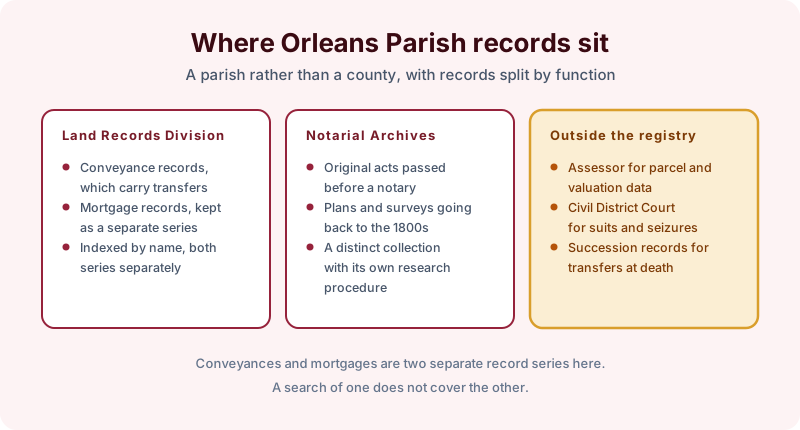
The Land Records Division keeps conveyance records and mortgage records as two separate series. Transfers are in the first, security instruments in the second, and each is indexed separately by name. A search of conveyances alone does not reach mortgages, which is the single most common error made by somebody applying county practice from elsewhere.
The Notarial Archives hold the original acts passed before notaries, going back to the eighteenth century, along with a remarkable collection of surveys and plans. In Louisiana an act of sale is passed before a notary and the original stays with that office, so the archive is a primary source rather than a historical curiosity.
The assessor holds parcel and valuation data. Suits, seizures and successions sit with Civil District Court.
What Complicates an Orleans Chain
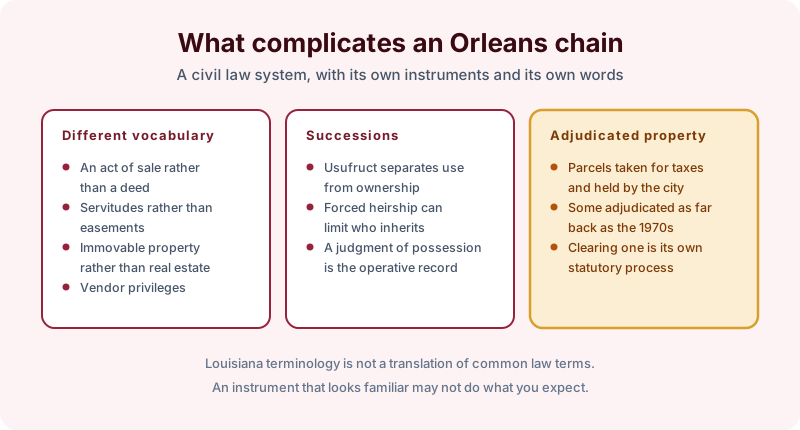
Start with the vocabulary, because the words are not translations. A transfer is an act of sale. What would be an easement elsewhere is a servitude. Real estate is immovable property. A seller's security for an unpaid price is a vendor's privilege. Treating any of these as a synonym for the common law term produces confident and wrong conclusions.
Transfers at death are the second difficulty. A succession is opened and the operative record is a judgment of possession, which is what actually places the heirs in ownership. Usufruct can separate the right to use property from ownership of it, commonly leaving a surviving spouse with the use while children hold what is called naked ownership, and forced heirship still constrains who may be disinherited in defined circumstances.
The third is tax adjudicated property. Parcels taken for unpaid taxes and adjudicated to the city sit in that status for years, in some cases since the 1970s, and clearing one involves a statutory process rather than an ordinary purchase. A chain that passes through an adjudication needs that process traced.
What Else Is Worth Knowing
Property here is frequently described by square and lot under the old city plans rather than by a rectangular survey description, and the municipal address attached to a square and lot has changed more than once. Matching an address to a legal description is real work in this parish rather than a formality.
Recovery programs after the 2005 storms left recorded covenants on a substantial number of properties, typically requiring elevation or occupancy for a stated period. Those are enforceable obligations running with the land and they turn up regularly in current searches.
Research on title here is customarily done through attorneys, and the certificates produced by the Land Records Division for conveyances and mortgages are the standard instruments for showing what a search covered.
Ordering an Orleans Parish Search
Send the municipal address, the square and lot where you have them, the tax bill number, and the owner name with any former names. Tell us if a succession, an adjudication or a recovery program covenant is known to be in the chain.
A current owner search covers the present vesting and what encumbers it, across both the conveyance and mortgage series. A full chain reaches back through the predecessor records and, where the property requires it, into the notarial archive. We will scope it before anything is ordered.