
Searching Pennington County Property Records
Pennington County covers a wide stretch of western South Dakota, from the Badlands in the east across to the Black Hills, with Rapid City at its center. It is the state's second largest county by population and one of its largest by area, which means a records search here can be a tidy city lot one week and a several thousand acre ranch the next.
The Register of Deeds Is the Recording Office
South Dakota uses a register of deeds rather than a recorder, and in Pennington County that office is in Rapid City. It keeps the county's deeds, mortgages, easements, plats, liens and satisfactions as computerized, filmed and scanned records, and the office also offers a property alert service that notifies an owner when something new records against their name.
South Dakota recording requirements are specific about what has to appear on an instrument. The names of the grantor and the grantee must be connected with the real property, the grantee's address is required, and a legal description has to be included. A certificate of real estate value accompanies most transfers, which is why consideration is often ascertainable on South Dakota deeds where it is not in other states.
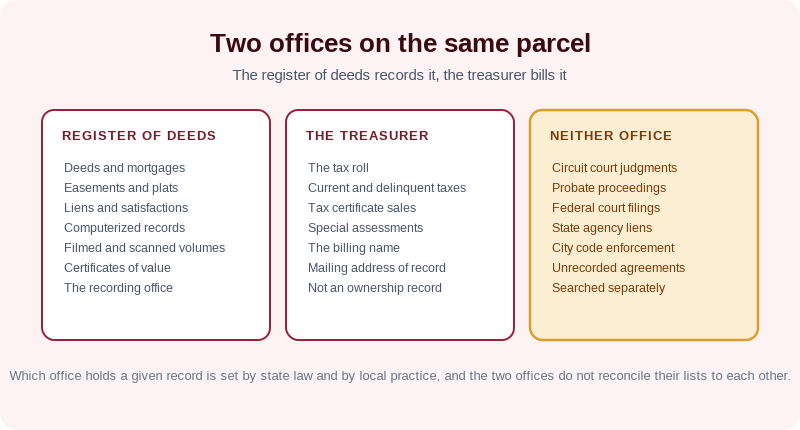
The treasurer is the other office people confuse with the first. It holds the tax roll, the delinquency list and the tax certificate process. The name there is a billing name, it is frequently out of date, and it has no authority over who owns anything.
What the Black Hills Adds to a Chain
Western South Dakota chains carry features the eastern part of the state does not, and they are easy to miss on a short search.
- Mineral severances. The Hills were mined long before most of the surface was platted, and severed mineral estates, reserved in old deeds and patents, are common. A surface deed that says nothing about minerals is not evidence the minerals came with it.
- Federal and state land. Large blocks are national forest, national park and state land, and private parcels frequently adjoin them with access running across them under grants recorded decades ago.
- Water. South Dakota administers water rights through a state agency, not the county, so a well or an irrigation right will not appear in the register's index at all.
- Ranch assemblages. Large holdings were assembled parcel by parcel, and the chain is several chains rather than one.
Scoping the Term
The search term does more work here than in a platted suburb. A shorter term establishes the current owner, the vesting deed, open mortgages and liens against that owner, which is enough for a refinance on a Rapid City house.
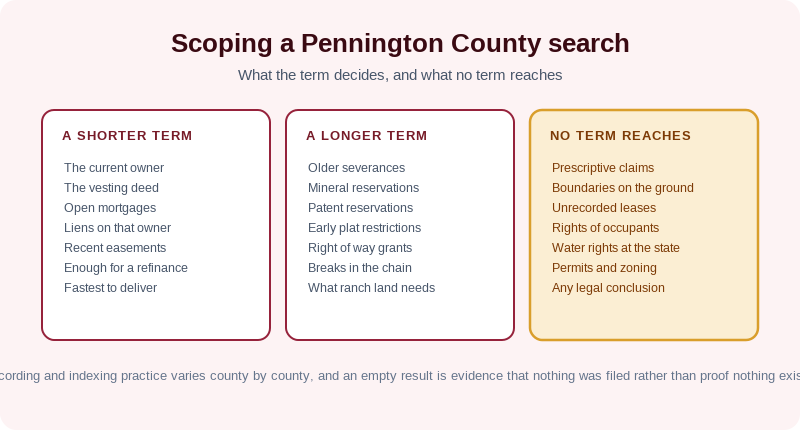
A longer term is what reaches the older severances, the patent reservations, early plat restrictions and right of way grants that govern rural ground. On ranch and recreational acreage, the document that matters most is routinely the oldest one in the file.
The parcel set is the other scoping decision, and it is the one people get wrong. A ranch that reads as a single tax parcel today may have been assembled from six homesteads, and a restriction recorded against one of those original tracts in 1931 binds only the acreage that tract covered. Searching the current parcel alone will not find it, and a buyer discovers it when a lender's underwriter does.
The Limits Worth Stating
A records search reports what was found of record in the county searched over the term searched, under the names run. Recording and indexing practice varies county by county, and an empty result is evidence that nothing was filed rather than proof that nothing exists.
It does not locate a boundary, which is a survey question, and it does not reach prescriptive claims, unrecorded leases or the rights of people in possession. Who owns what today is a legal conclusion for an attorney licensed in South Dakota.
AFX Research runs Pennington County searches with certified abstractors, nationwide, and we will scope the term to the question before anything is ordered.