

Searching Philadelphia Property Records
Philadelphia is the unusual case in Pennsylvania. The city and the county are the same jurisdiction, consolidated in 1854, so there is no separate county recorder of deeds sitting outside city government. Everything that gets recorded against a parcel here is recorded with a city department, and the search is arranged around that fact.
Knowing which office answers which question is most of the work.
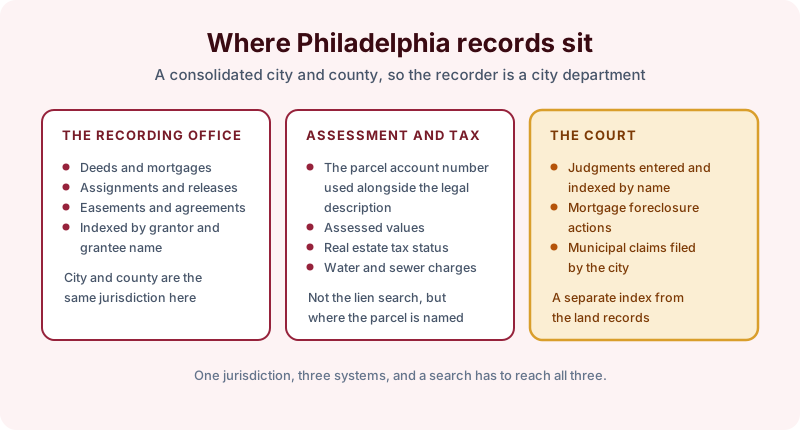
One jurisdiction, three systems
The recording office holds the land side. Deeds, mortgages, assignments, satisfactions, easements and agreements are filed and indexed there by grantor and grantee name. Because the city and county are coextensive, there is no second office across town to check.
The assessment and tax side is where a street address becomes a parcel. The city assigns each property an account number that gets used alongside the legal description, and it carries assessed value, real estate tax status and the city charges that attach to the property. It is the fastest route from an address to a parcel, and it is not evidence of ownership, since the roll follows the recorded deeds rather than the other way round.
The court holds judgments, indexed by name. Nothing in that index is keyed to the land, so a search that stops at the recorded deeds and never runs the owner names has read half the record.
Municipal claims are the Philadelphia specialty
Pennsylvania law gives municipalities a mechanism for securing unpaid charges against the property itself, and Philadelphia uses it heavily. Unpaid water and sewer charges, demolition and cleaning costs, and other city charges can become claims against the parcel rather than debts of the person who ran them up.
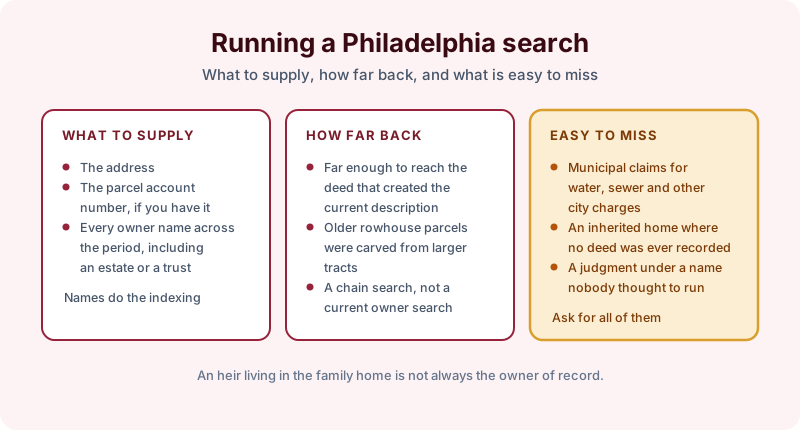
That matters for two reasons. The claim follows the land, so a buyer can inherit it. And it will not appear in a search that looks only for mortgages and judgments, because it is filed as its own category. Ask for it by name when you order.
Code and licensing violations are a related but separate file, held by the city department that issues them. Some generate a recorded claim and many do not, so the land record is an incomplete picture of a property's compliance history.
Rowhouse chains and the parcels behind them
Philadelphia's housing stock is old, and a great deal of it was built in long rows carved out of larger tracts. The description on a current deed frequently traces back to a subdivision that happened in the nineteenth or early twentieth century, and the party wall arrangements, alley rights and rear access that go with a rowhouse were often created in that original instrument rather than in anything recent.
That is the practical argument for a chain search rather than a current owner search here. The instrument that decides whether a buyer has a recorded right to the shared alley is rarely the most recent one in the file.
Inherited homes and the deed that was never recorded
One pattern comes up in Philadelphia more than almost anywhere else. A family home passes to the next generation, the heirs live in it for years, and no deed is ever recorded because the estate was never opened. The occupants are the owners in every sense that matters to them, and the record still shows a person who died decades ago.
A search reports what has been recorded, so it will show that deceased owner accurately. Resolving it takes a probate proceeding or a court action, which is a legal matter rather than a records one. The useful thing a search does is establish exactly what the record says, which is the starting point for any of it.
What a Philadelphia search covers
Send us the address, the parcel account number if you have it, and every owner name across the period you want covered, including an estate or a trust. The names are what the index actually runs on.
A search reports what was recorded and found in the indexes reviewed over the term searched. It is not an inventory of everything affecting the property, an empty result does not prove there is nothing to find, and whether title is marketable is a legal conclusion for an attorney licensed in Pennsylvania.