

Searching Polk County Property Records
Polk County is the center of gravity for Iowa real estate. Des Moines sits inside it, the county is the most populous in the state, and the suburbs north and west of the city have carried steady development for thirty years. That volume is good news for a searcher, because the records are well kept and the offices are used to being asked. What it does not do is remove the local details, and Iowa has a few of its own.
Which Office Holds What
The Polk County Recorder holds the land records. Deeds, mortgages, assignments and releases, easements, plats, recorded covenants, and liens filed against either the land or the owner. That is the office a title search works in, and it is the only one of the three that speaks to ownership.
The assessor and the treasurer hold the other half of what people think of as property records. Parcel numbers, assessed values, the name the tax bill goes to, the current tax status and any delinquency or tax sale. Those offices are useful and they are not the record of title. An assessor card naming somebody is not evidence that the person owns anything.
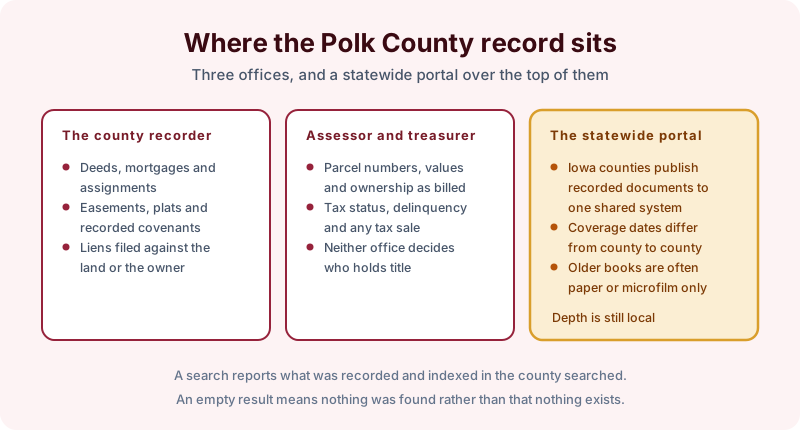
Over the top of all of it sits a statewide system. Iowa counties publish recorded documents to a single shared portal, which is unusual and genuinely helpful, because it means one interface rather than ninety nine. What it does not do is make coverage uniform. The date each county's images begin differs, older books remain paper or microfilm in many places, and depth is still a local question.
Two Filings That Travel With the Deed
Iowa pairs most deed recordings with two companion documents, and both are worth asking for.
The declaration of value states the consideration on a taxable transfer. It is filed at the same counter, and the assessor uses it. Exempt transfers state the exemption rather than a price, which is why a gift deed or a transfer between family members shows no figure at all.
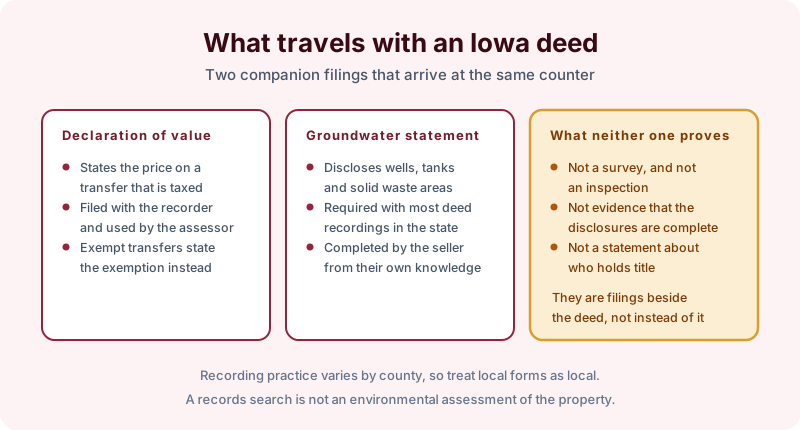
The groundwater hazard statement is the one that surprises people from other states. It discloses wells, underground storage tanks, disposal sites and known hazardous waste on the property, and it is required with most deed recordings in Iowa. It is completed by the seller from their own knowledge, which is exactly as reliable as that sounds. It is a filing beside the deed rather than a substitute for an inspection or an environmental assessment.
What Iowa Does Instead of Title Insurance
Iowa is the one state where title insurance is not generally sold to the public. In its place the state runs a public title guaranty program, and the practical effect for a buyer or a lender is that the abstract of title does more work here than it does almost anywhere else.
An abstract is a continuing summary of everything recorded against a parcel, prepared by an abstractor and brought forward each time the property changes hands. The physical abstract travels with the property, an attorney examines it and issues an opinion, and the certificate rests on that opinion. A records search is a different product from an abstract continuation, and if an Iowa closing is what you are preparing for, the abstract is usually the document the lender actually wants.
What a Search Will and Will Not Settle
A search of the Polk County land records reports what was recorded and indexed there, over the period searched, with copies of the instruments found. That covers the chain of title, the mortgages and assignments, the recorded easements and covenants, the liens filed against the land or the owner, and the plat if one governs the parcel.
It does not establish who owns the property today, which is a legal conclusion rather than a search result. It does not report zoning, permits, code enforcement or building condition. It is not a survey and it does not locate a boundary on the ground. And recording practice varies by county, so an empty result means nothing was found rather than that nothing exists.