

Searching Providence County Property Records
Providence County covers the capital and fifteen other municipalities, and the single most useful thing to know about searching property here is that the county itself has no records. Rhode Island abolished county government, and the land evidence records are kept by each city and town.
That one fact reorganizes everything else.
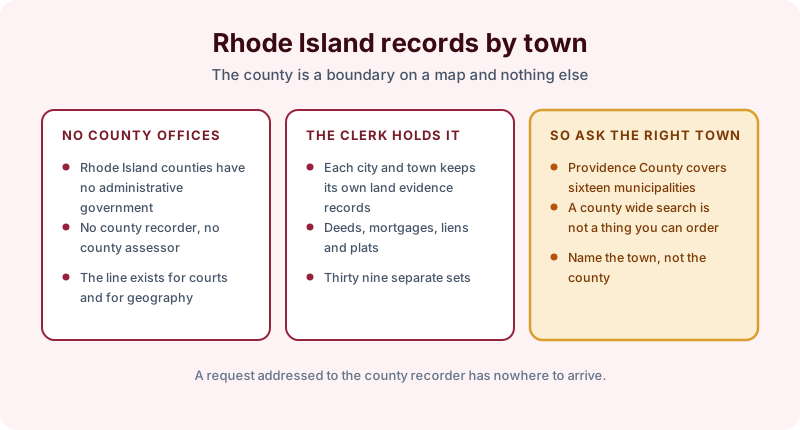
There is no county recorder here
Rhode Island counties exist as geographic and judicial divisions and have no administrative government. There is no county recorder, no county assessor and no county clerk holding deeds. A request addressed to any of those has nowhere to arrive.
What exists instead is thirty nine separate municipal record offices, one for each city and town in the state. The city or town clerk keeps the land evidence records for property within that municipality, meaning deeds, mortgages, liens, easements and plats, indexed locally.
For Providence County that means sixteen separate sets of books. A search of the county as a unit is not something that can be ordered, because there is no office that holds the county as a unit. The search has to name the municipality, and getting that right is the first step rather than a detail.
Municipal boundaries have also moved over the centuries, and older Rhode Island towns have been divided and renamed. A chain that runs back far enough can cross from one town's books into another's, which is a reason to say plainly where the search looked.
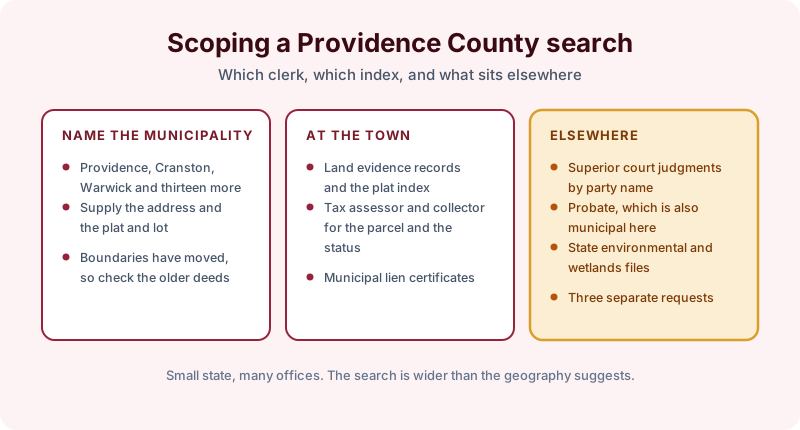
What sits at the town, and what does not
At the municipality you will find the land evidence records and the plat index, and separately the tax assessor and collector holding the parcel data and the tax status. Rhode Island practice also uses a municipal lien certificate, a document issued by the town setting out the taxes, water, sewer and other municipal charges outstanding against a property. That certificate is a standard part of a Rhode Island closing and it is obtained from the town rather than derived from a records search.
Away from the town, three things sit elsewhere. Judgments are entered in the state superior court and indexed by party name. Probate in Rhode Island is also municipal, heard by town probate courts rather than a county court, which is unusual and worth knowing when an estate appears in a chain. Environmental and wetlands files are held by state agencies, and on coastal or riverfront ground there is a further state body with its own records.
So a complete picture of a Providence County property typically means three separate requests to three kinds of office, and only one of them is the land records.
What the chain tends to carry
Expect depth. Providence has been continuously settled since the 1630s, and a downtown parcel can carry conveyances back into the eighteenth century in handwriting, with descriptions calling for stone walls, trees and neighbors long gone.
Expect old restrictions as well. Mill properties along the rivers carry water rights, raceway and flowage arrangements left from the textile era, and nineteenth century subdivisions carry covenants nobody has looked at in a century. Those are usually recorded against the original tract rather than against the lot being sold, so reaching them is a question of how far back the search runs.
Ordering a Providence County search
Supply the street address, the municipality by name, and the plat and lot numbers the town uses, along with every name the property has been held in. Say whether the chain runs through an estate, because that points at a town probate court rather than at the land records.
A title search reports what was recorded and indexed in the offices searched, as of the day the work was done. It is not proof that nothing else exists, it is not a title insurance commitment, and it is not a legal opinion. Practice varies from one Rhode Island town to the next, so our report names the offices and indexes reviewed and attaches copies of what was found.