
Searching Pulaski County Property Records
Pulaski County holds Little Rock, North Little Rock and most of central Arkansas's population, and a property search there runs through an office whose name tells you almost nothing about what it does. Arkansas has no separate recorder of deeds. The function belongs to the circuit clerk, who is also the clerk of the circuit court.
That is the first thing to get straight, and the second is that the county clerk, which sounds like it ought to be the same office, is a different elected position doing different work.
One elected office holding two sets of records
The circuit clerk in each Arkansas county serves as ex officio recorder, which puts the land records and the civil court file under the same elected official. In Pulaski County the real estate function runs as its own department within that office.
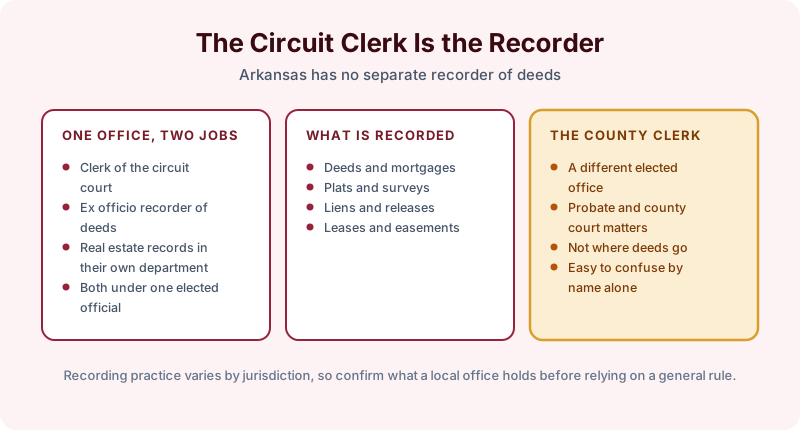
The recording side takes deeds, mortgages, plats, liens, leases and easements, along with the releases that clear them. The court side holds civil case files, and judgments entered there become liens on real property in the county under state law rather than by a separate recording step in every instance.
They are still two indexes maintained for two purposes. A report that says the county records were searched is not saying much until it says which side it covered.
Where the county clerk fits
The county clerk is a separate office handling probate, county court matters, voter registration and the county's own financial records. Estates are its business, and an estate file can matter a great deal to a chain of title where property passed at death.
Confusing the two offices is easy and costly. A request for a deed sent to the county clerk goes nowhere, and a request for a probate file sent to the circuit clerk's real estate department goes nowhere either. Naming the record you want rather than the office you expect is the reliable approach.
Delinquent taxes leave the county entirely
Arkansas handles tax-delinquent land differently from most states, and it is the feature most likely to surprise someone searching here for the first time.
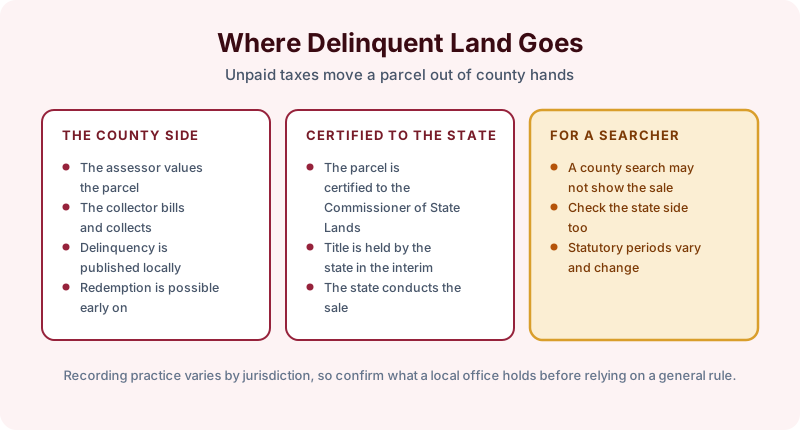
The county assessor values the parcel and the county collector bills and collects, as anywhere. When taxes go unpaid, the parcel is eventually certified to the Commissioner of State Lands, a state office, and it is the state rather than the county that holds and ultimately sells it. Redemption runs through that office too.
For a searcher this means a parcel's tax history can leave the county record partway through. Statutory periods for certification, redemption and sale are set by state law and have been amended over the years, so the dates that applied to a 1998 delinquency are not necessarily the dates that apply now. Those are questions for counsel rather than for an abstract.
Reading an older Pulaski chain
Central Arkansas has a long and well-documented record, and chains here run back through territorial conveyances in places. A few things recur.
- Descriptions mix platted lots in the older city neighborhoods with metes and bounds and section calls just outside them, sometimes within the same chain.
- Levee and drainage district assessments appear along the Arkansas River bottoms and are recorded separately from ordinary taxes.
- Annexation has moved parcels into and out of municipal boundaries repeatedly, which affects municipal liens without affecting the county record at all.
What a Pulaski County search returns
An AFX search reports the recorded instruments found of record for the property and term you name, with copies. That covers the chain of title, mortgages and their assignments and releases, judgments and tax liens found of record, easements and restrictions, plats, and any recorded lease or memorandum.
It reports what was recorded and indexed in the offices searched. It is not a complete inventory of everything affecting the parcel, an empty result does not establish that nothing exists, and an unrecorded interest leaves no trace anywhere a search can reach. Recording and indexing practice varies county by county in Arkansas, and the legal effect of any instrument is a question for an attorney licensed in the state.