

Searching Roanoke City Property Records
Searching property records in Roanoke, Virginia starts with a question that does not come up in most states. Which Roanoke? The City of Roanoke is an independent city, which in Virginia means it sits inside no county at all and keeps a complete set of land records of its own. Roanoke County surrounds it, has its own courthouse in Salem, and keeps a separate set. Order against the wrong one and the search returns nothing, correctly.
Virginia is the only state that uses independent cities at this scale, with dozens of them, and the arrangement runs back to the nineteenth century. For anyone ordering a title search it is the single most important local fact.
City or county, before anything else
A mailing address is not evidence of jurisdiction. Plenty of parcels carry a Roanoke address while sitting in Roanoke County, because postal routes do not follow corporate boundaries. The parcel identifier settles it, and so does the assessment record, which is maintained separately by each jurisdiction.
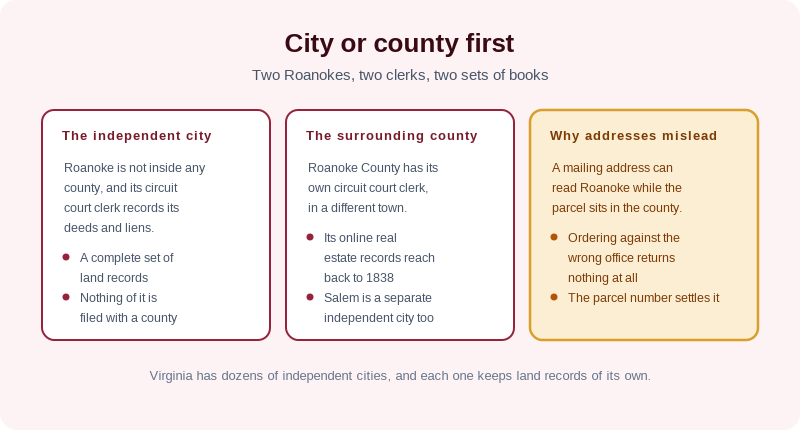
Where the parcel is in the city, everything is recorded with the clerk of the Roanoke City Circuit Court. Where it is in the county, the records are with the Roanoke County circuit court clerk, whose online real estate records reach back to 1838. Salem is its own independent city as well, so a third set exists just west of both. None of the three files anything with the others.
What the circuit court clerk holds
Virginia puts land recording in the hands of a court clerk rather than a separate recorder, which has a consequence worth knowing. The deeds and the judgments are in the same office.
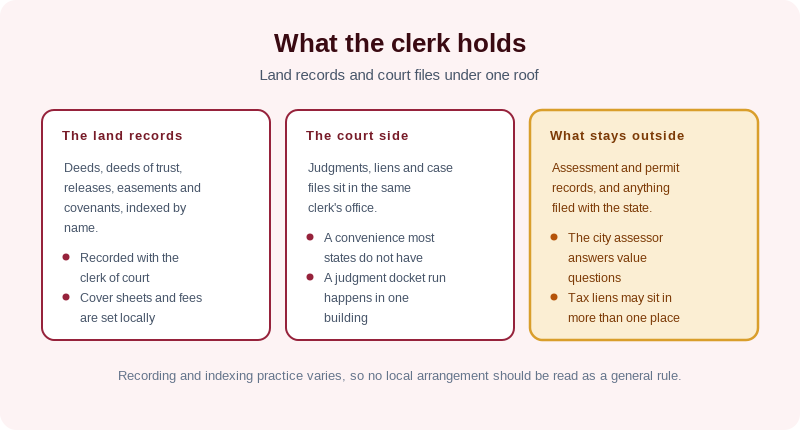
On the land side the clerk records deeds, deeds of trust, releases, easements, covenants and liens, indexed by the names of the parties. On the court side the same office holds the judgment docket and the case files, so a judgment run and a chain of title can be completed in one building, which is not true in most states. What stays outside are the assessment and permit records, held by the city, and anything filed with a state agency.
What a chain in this area tends to carry
Roanoke grew as a railroad town, and the land records show it. Chains frequently run back through railway company conveyances, and older instruments in the valley carry rights of way, spur track easements and reversionary language tied to railroad use. Virginia is also a deed of trust state rather than a mortgage state, so the security instrument names a trustee and a nonjudicial sale is the usual foreclosure route, which changes what a release looks like and who signs it.
Properties in the older neighborhoods may also sit under recorded covenants from the early twentieth century. Some of those contain racial restrictions that have been unenforceable for decades and remain physically present in the record, and Virginia provides a process for recording a document disclaiming them. An abstractor reports what is in the book, including language of that kind, because leaving it out of a report would misstate what the record contains.
Ordering a search in Roanoke
Tell us the address and, if you have it, the parcel identifier, and we will confirm which jurisdiction the parcel sits in before the order is placed. Tell us the names you want run and the term you need, and where a judgment search is part of the scope we will say so explicitly rather than assuming it.
A records search reports what was found of record in the office searched, over the term searched. It is not an inventory of everything that exists, and an empty result does not prove a parcel is unencumbered. Recording and indexing practice varies between the city and the county and from one clerk to the next, so no local arrangement should be read as a general rule. Whether a recorded instrument is effective, and who holds title today, are legal conclusions for an attorney licensed in Virginia.