
Searching Rockingham County Property Records
Rockingham County covers New Hampshire's short seacoast and the towns inland from it, from Portsmouth and Exeter out to Salem and Derry. Searching property records there is a county job, which is ordinary enough, but two things about the New Hampshire arrangement differ from what researchers expect, and one of them runs back three and a half centuries.
Start with the registry itself, because its depth sets the terms of the work.
A registry with colonial roots
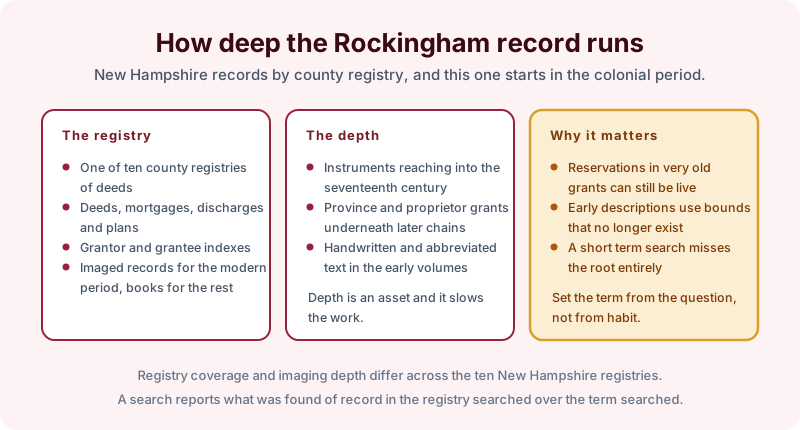
New Hampshire records land through ten county registries of deeds, and Rockingham's is among the oldest continuously kept record sets in the country. Deeds, mortgages, discharges, easements and recorded plans all go there, indexed by grantor and grantee name.
The modern record is imaged and searchable. The early volumes are not, and they are handwritten, heavily abbreviated and occasionally in a hand that takes practice to read. Beneath the ordinary chains sit province era grants and proprietor divisions, and reservations made in those instruments can still be live three hundred years later.
The practical consequence is that term selection matters more here than in a county whose records begin in 1850. A short current owner search answers a narrow question. On an older parcel, particularly one carved out of a larger farm, the instrument that controls may be far older than anything a routine search would reach.
Land use is a town matter
New Hampshire has no county zoning. Zoning, subdivision approval, site plan review, building permits and septic approvals are all municipal, held in a town office, and none of it is recorded against the parcel at the registry. A clean registry result says nothing about whether a use is permitted.
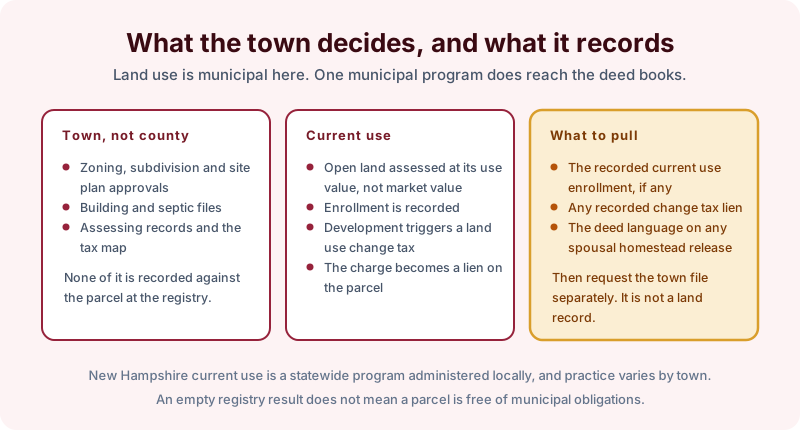
One municipal program does reach the deed books, and it is the one most likely to surprise a buyer. Under the state's current use program, open land is assessed at its use value rather than its market value, the enrollment is recorded, and developing the land triggers a land use change tax that becomes a lien on the parcel. On a wooded lot being bought for a house, that charge can be substantial and it is attached to the land rather than to the seller.
Other things worth pulling
- Transfer tax stamps on the deed, which are paid by both buyer and seller in New Hampshire and are a useful check on the stated consideration.
- Homestead releases, since a spouse holds a statutory homestead right that is ordinarily released in the deed itself.
- Abandoned rail and trail corridors, which run through a good deal of the county and carry reversionary questions in the original grants.
- Shoreland and wetland restrictions, which are state programs and are recorded only sometimes.
Setting the scope
Portsmouth and the older seacoast towns add one more wrinkle. A great many downtown parcels were described by reference to neighbors and to features that have since been removed, so a bound called as the corner of a wharf or a now demolished block has to be reconstructed from later deeds rather than located directly. That is ordinary abstracting work, and it takes time that a routine current owner search does not budget for.
Supply the legal description, the town, and the tax map and lot number, because New Hampshire parcels are identified locally by map and lot rather than by a uniform statewide number. Give every owner name over the term. Say whether the question is current ownership or the full history, since the answer determines whether the search stops at a modern root or works back into the early volumes.
A search reports the deeds and mortgages, the liens, judgments and lis pendens, and the easements, covenants and recorded plans found of record for the parcel over the term searched, with copies of the instruments. It does not reach the town zoning, building or septic file, does not confirm current use standing with the assessor, and does not establish whether a colonial reservation remains enforceable. Nothing found of record is not proof a parcel is unencumbered, and recording and indexing practice varies by county.