

Searching San Juan County Property Records
San Juan County sits in the Four Corners, with Farmington, Aztec and Bloomfield along the San Juan River and the Navajo Nation covering a large part of the county to the south and west. It has been an oil and gas county since the nineteen twenties, and that history is written through its land record more thoroughly than through almost any other record in the state.
The result is that a chain here usually describes two estates rather than one, and a search scoped to the surface alone answers half the question.
The county clerk holds the land record
New Mexico counties keep land records with the county clerk, who maintains the recorded series of deeds, mortgages, releases, liens, easements, plats, oil and gas leases and assignments, indexed under the names of the grantor and the grantee.
Land outside the older river settlements is described on the public land survey grid by township, range and section, with subdivision lots and surveys layered over it. Descriptions in the basin frequently carry acreage expressed as a fraction of a section, which is a convention worth reading carefully, because a quarter of a quarter section is a very different thing from a quarter of a section.
Two record sets sit outside the clerk's office and matter constantly here. Title to land held in federal trust for the Navajo Nation or for individual allottees is kept by the federal government rather than by the county, and a county search does not reach it. Oil and gas regulatory files, including well permits, spacing orders and production data, belong to the state rather than to the recorder.
Community property changes who signs
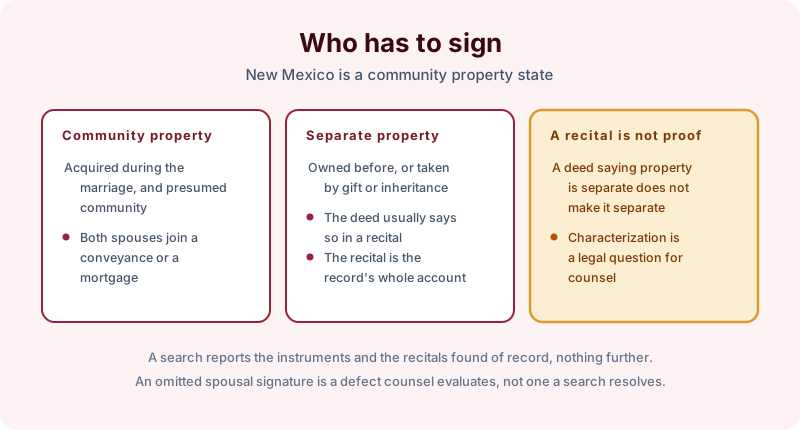
New Mexico is a community property state. Property acquired by either spouse during a marriage is presumed to belong to the community, and a conveyance or a mortgage of community real property generally needs both spouses to join it.
Separate property, meaning property owned before the marriage or received by gift or inheritance, is handled differently, and a deed will usually say so in a recital. The recital is the whole of what the record has to offer on the point. A deed stating that property is separate does not make it separate, and whether a particular parcel is community or separate is a legal question for New Mexico counsel.
The practical consequence for a search is that a missing spousal signature in an older conveyance is a finding worth reporting rather than an oddity to pass over, and that running both spouses' names matters as much as running the name on the deed.
The mineral estate under the surface
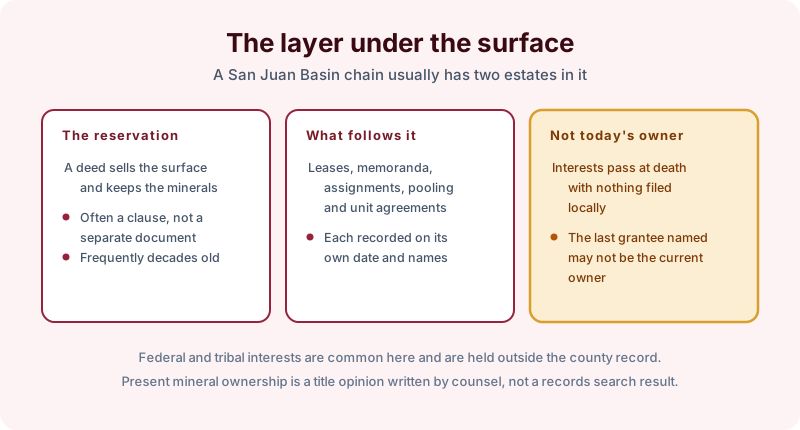
Severed minerals are ordinary rather than exceptional in the San Juan Basin. A deed from the nineteen thirties sells the surface and reserves the minerals in a single sentence, and everything that follows attaches to the estate that sentence created.
What a chain then carries is a long sequence of leases, memoranda of lease, assignments, ratifications, pooling declarations and unit agreements, each recorded on its own date under its own names. Reading them is slow work and there is no shortcut, because the reservation that started it is usually a clause inside a document about something else.
A records search can show the instruments found of record over the term searched. It cannot establish who owns the minerals today, because interests pass at death with nothing filed in the county at all, and present mineral ownership is a title opinion written by counsel rather than a search result.
What to send with the order
Send the full legal description with the township, range and section, the assessor's parcel number if you have one, and the complete names of every owner across the period you care about, including former names and entity names.
Say whether you need the surface, the minerals or both, and say how far back. A current owner search answers what is recorded against the present owner. Reaching an original reservation means a chain long enough to include the decade it was written in, and in this county that is usually further back than people expect.
A search reports what was recorded and indexed in this county over the term searched. It is not an inventory of everything affecting the property, an empty result does not establish that nothing exists, and recording practice varies from county to county across New Mexico.