

Searching Sedgwick County Property Records
Kansas does something at the recording counter that most states do not. With very few exceptions, a deed will not be accepted for recording unless a completed sales validation questionnaire comes with it, or the deed itself states on its face why no questionnaire is required. The register of deeds checks for it, and a document that arrives without one goes back.
For anybody reading a Kansas chain of title, that single requirement shapes what the record looks like. Sedgwick County, which covers Wichita and the towns around it, is the second most populous county in the state and its register of deeds handles a large volume of transfers, so the pattern is easy to see there.
The questionnaire that travels with a deed
The Kansas Real Estate Sales Validation Questionnaire reports the sale price and the terms of the transfer along with the parties and the property, and it may be completed by the buyer, the seller or an agent. The data feeds the county appraiser rather than a transfer tax, since Kansas does not levy one on conveyances.
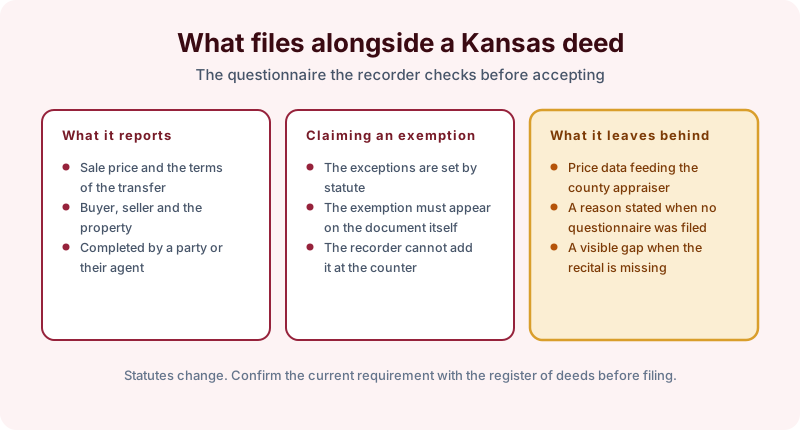
Exemptions exist, they are set by statute rather than by practice, and the important procedural point is that an exemption has to appear on the document being filed. The register cannot add it at the counter. That produces a readable artifact in the chain, because a deed recorded under an exemption usually carries a recital naming it, and a searcher can see which transfers were sales and which were something else.
It is worth saying plainly that these requirements change. Statutes are amended, directives are reissued, and the current rule should be confirmed with the register of deeds rather than taken from a description of how it worked a few years ago.
A fee change that shows in the record
Kansas used to charge a mortgage registration tax calculated against the principal amount of a mortgage, and in 2014 the legislature voted to phase it out. The reduction ran across the following years and the tax was repealed beginning in 2019, with per page recording fees raised across the same period to offset the loss to counties.
That matters to a searcher mainly as context. Mortgages recorded before and after the change were papered under different cost pressures, and the practices that grew up around minimizing the old tax, including some structures built to reduce the amount due, are visible in older instruments. Reading a 2011 mortgage with 2026 assumptions can lead you astray.
Which office answers which question
The register of deeds holds the land records, which in Kansas includes oil and gas leases and assignments alongside the deeds, mortgages, easements, plats and restrictions. Kansas has real production history, and severed mineral interests appear in the same index rather than in a separate system.
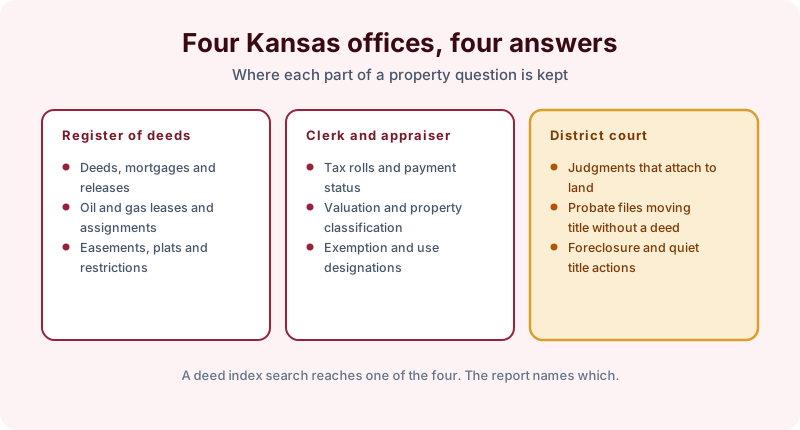
The county clerk and the county appraiser hold the tax side, meaning the rolls and payment status, the valuation and classification, and whatever exemption or use designation applies to the parcel. Neither is reachable from a deed index search.
The district court is the third place, and it holds judgments that attach to land, probate files that move title without a deed being recorded, and foreclosure and quiet title actions. A chain that appears to stop at a death frequently continues there.
How to scope a Sedgwick County order
Give us the parcel identification and legal description, the owner names you have including prior owners, and the term you need. Say whether oil, gas and other mineral interests are part of the question, because in Kansas they sit in the same index and a search can report them without a separate order.
Tell us as well whether you want the tax and valuation status pulled alongside the recorded instruments, since that is a request to a different office, and whether judgments and probate need to be searched at the district court.
A records search reports what was recorded in the office searched over the term searched, with copies of the instruments found. It is not an inventory of everything affecting a parcel, and an empty result means nothing was found rather than that nothing exists. Recording and indexing practice varies county by county, and whether a particular instrument is effective is a legal question for an attorney licensed in Kansas.