

Searching Westchester County Property Records
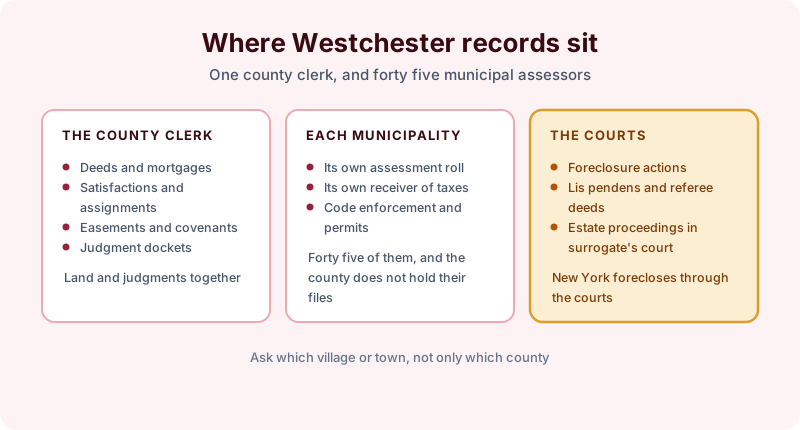
Westchester County sits immediately north of New York City, running from Yonkers and Mount Vernon up through White Plains to the northern towns along the Hudson and the Connecticut line. Forty five cities, towns and villages sit inside it, and the first thing to know about searching here is that the county holds the land record while the municipalities hold almost everything else.
The second thing is that a meaningful share of the housing stock is not real property at all.
The county clerk holds the land record
New York makes the county clerk the recording officer outside New York City, so deeds, mortgages, satisfactions, assignments, easements and restrictive covenants are all filed and indexed there by name. The same office maintains the judgment docket, which matters more here than the arrangement suggests.
A money judgment in New York is docketed with the county clerk, and once docketed it attaches to real property the debtor owns in that county. The lien runs for ten years and can be renewed. That two step is worth holding onto, because a judgment entered in one county does not reach land in another until somebody dockets it there.
New York also forecloses through the courts. A mortgage foreclosure here produces a lawsuit, a recorded notice of pendency, a judgment of foreclosure and sale, and a referee's deed, with the court file sitting alongside the recorded instruments. A chain that runs through a foreclosure reads more completely here than it would in a state using a power of sale.
A co-op is not real property
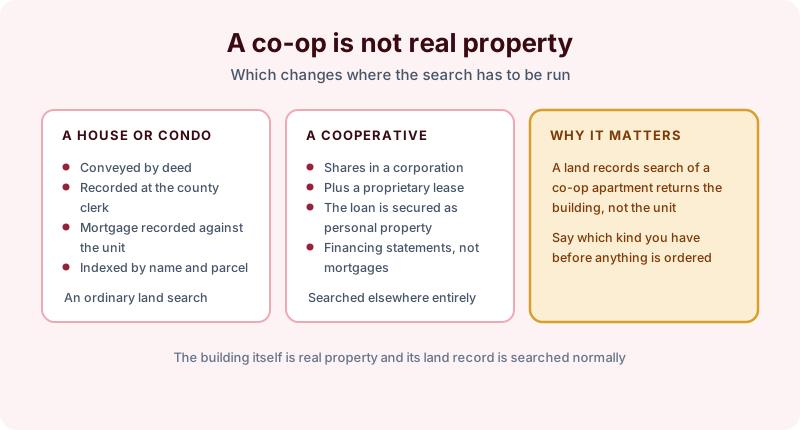
This is the New York specific point that catches out anyone arriving from another state, and Westchester has a great deal of cooperative housing in its southern cities.
Buying a co-op does not get you a deed. It gets you shares in a corporation that owns the building, together with a proprietary lease entitling you to occupy a particular apartment. Those shares are personal property. A loan against them is secured as personal property and perfected through a financing statement rather than through a mortgage recorded against the unit.
The practical consequence is that a land records search of a co-op apartment returns information about the building and nothing about the apartment. If you are searching a unit, say at the outset whether it is a condominium or a cooperative, because the answer changes which system holds the answer.
Condominiums behave normally. The declaration and the floor plans are recorded, each unit has its own tax lot, and a deed conveys it.
The municipality matters as much as the county
Forty five municipalities means forty five assessment rolls, forty five receivers of taxes and forty five code enforcement departments. Assessment in New York is done at the town and city level, not by the county, so there is no single county wide roll to consult.
Unpaid taxes, water charges and code violations are municipal matters, and the enforcement route differs across the county. A county search reaches the recorded instruments. It does not reach a village ledger, and the two have to be asked separately.
What to send us
The address and the section, block and lot designation if you have it, since that is how New York identifies tax parcels. The municipality, because the county index will not carry a village file. The full name of every owner in the period you care about, including any estate or trust name. And whether the property is a house, a condominium or a cooperative.
The mortgage recording tax is worth mentioning for anyone budgeting a transaction here, since New York charges one and Westchester adds its own portion on top of the state rate. It is a closing cost rather than a title question, and people from other states are routinely surprised by it.
What a Westchester County search establishes
A search reports what was recorded and found in the indexes reviewed over the term searched, in the county where the property sits. It is not an inventory of everything affecting a property, an empty result does not prove a parcel is unencumbered, and recording and indexing practice varies from one New York county to the next. Whether title is good, whether a docketed judgment still attaches, and whether a co-op interest is clear are conclusions for an attorney licensed in New York.