

Searching Yellowstone County Property Records
Yellowstone County is Montana's most populous county, built around Billings where the Yellowstone River comes out of the mountains and the plains begin. The county carries a refinery corridor, a hospital district, irrigated bottomland along the river and dryland farming and grazing beyond it, and the land record reflects all of that in the same index.
Three features of Montana practice shape what a search here can and cannot answer, and none of them is obvious from a deed.
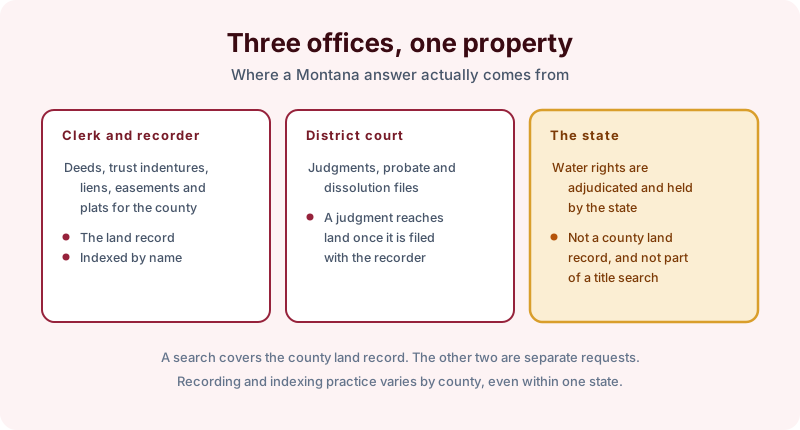
The clerk and recorder holds the land record
Montana counties keep land records with the clerk and recorder, who maintains the book and page or document number series carrying deeds, trust indentures, mortgages, liens, easements, plats and assignments, indexed under the names of the parties rather than against a parcel number.
Land is described on the public land survey grid, by township, range and section, with subdivision lots and certificates of survey layered over it where ground has been divided. A certificate of survey is Montana's instrument for a division that does not go through the full subdivision process, and reading the certificates in a chain is often the only way to understand how a tract reached its present shape.
Judgments are entered by the district court, which sits in a separate office and keeps a separate file. A judgment does not reach land in the county until something is filed with the clerk and recorder, which is the step a land records search looks for.
A trust indenture is not a mortgage
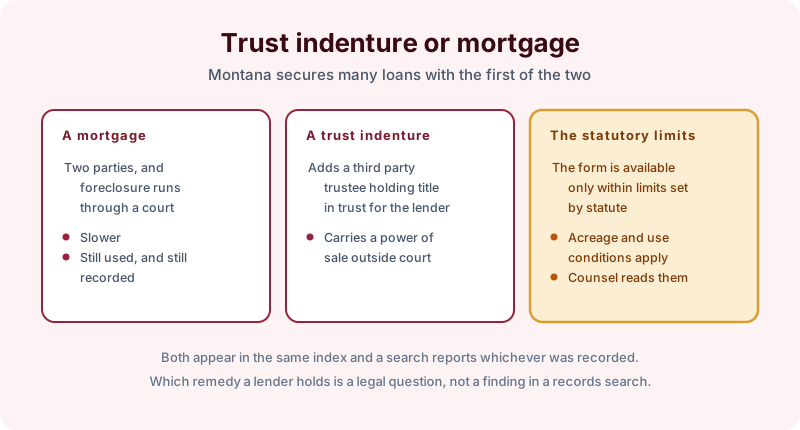
Montana secures a great many loans with a trust indenture rather than a mortgage. The difference matters because a trust indenture brings in a third party trustee who holds title in trust for the lender, and it carries a power of sale that allows foreclosure to run outside a courtroom.
The form is available only within limits the statute sets, so both instruments turn up in the same index and a chain can contain each in turn. What a search reports is whichever instrument was recorded, with the document attached. Which remedy a lender actually holds, and whether a particular indenture qualified under the statute, are questions for Montana counsel rather than findings in a records search.
Reconveyances are the companion document to watch. A trust indenture is released by a reconveyance from the trustee, and an unreleased indenture from 1998 is a routine finding on an older chain.
Price is not part of the record
Montana is a non disclosure state. A deed is accompanied by a realty transfer certificate, which reports the price to the state, and that certificate is treated as confidential rather than filed into the public land record. A search of the chain will tell you who conveyed what and when. It will not tell you what anything sold for.
Two other files sit outside the county record and come up on nearly every rural or riverfront parcel here. Water rights are adjudicated and administered by the state rather than the county, so a land records search does not confirm a water right or its standing. And where land is held in federal trust, the title record is kept by the federal government rather than by the clerk and recorder.
What to send with the order
Send the full legal description, including the township, range and section or the certificate of survey number, together with the assessor's parcel number if you have it. Send the complete names of every owner in the period you care about, including former names and entity names, because the index runs on names.
Tell us the term you need. A current owner search answers who holds title now and what is recorded against them. A longer chain is what reaches an old reservation, an unreleased indenture or an easement granted three owners ago.
A search reports what was recorded and indexed in this county over the term searched. It is not an inventory of everything affecting the property, an empty result does not establish that nothing exists, and recording practice varies from county to county across Montana.